

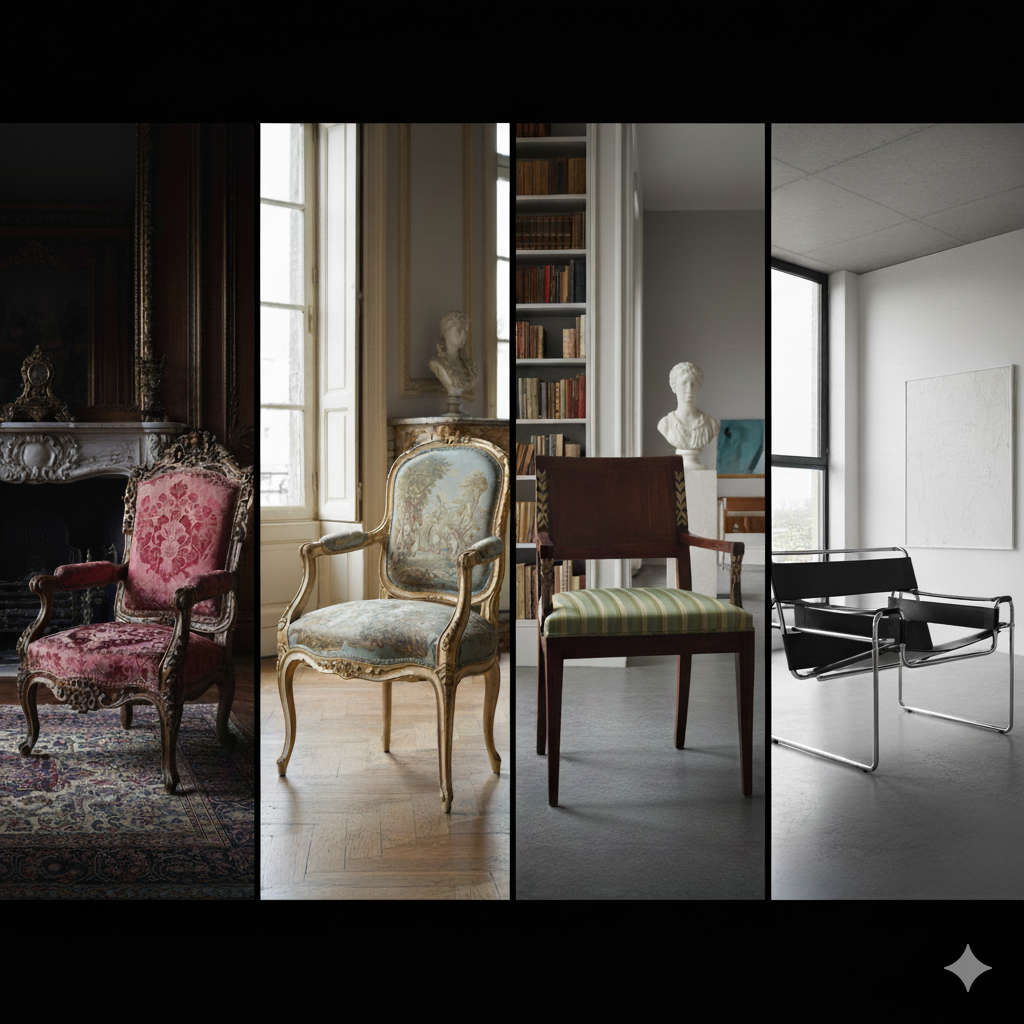
Every antique chair is much more than just a functional object: it’s a mirror reflecting an era, a culture, a taste. Recognizing a chair’s style means interpreting its lines, proportions, and decorative details to trace its historical origin and the social context that produced it. Whether it’s a dining chair, a living room chair, or a desk chair, each piece carries the distinctive traits of the period in which it was created. This article serves as a guide for navigating the most important styles that have marked the history of chairs in Europe, from the Baroque period to early Modernism, for those who wish to restore, collect, or simply furnish with awareness.
The Baroque Period (late 17th – early 18th century)
Baroque chairs are among the most theatrical and imposing. Characterized by solid and richly carved forms, they feature high backs, elaborate carvings (scrolls, flowers, heraldic motifs), curved armrests, and turned or shaped legs, often in the form of lion’s paws. The most commonly used materials were walnut, beech, and oak, sometimes with gilding or inlays. Upholstery, when present, was in leather, velvet, or brocade, fixed with ornamental tacks. A Baroque chair is recognizable by its grandiosity: it is made to be noticed.
The Rococo Period (early 18th century)
The Rococo style, also known as “Louis XV” in France, introduces an idea of more sinuous and frivolous elegance. Chairs become lighter, with curved profiles, shaped backs, cabriole legs, and more delicate decorative motifs. Decorations are inspired by shells, flowers, plant motifs, and asymmetrical lines. Woods are often lacquered in pastel colors and decorated with gilding or polychrome motifs. The seats are wide, comfortable, and upholstery becomes central. Rococo chairs are among the most sought after by lovers of romanticism and French elegance.
Neoclassicism (late 18th – early 19th century)
With the “Louis XVI” style and Napoleonic influences, there is a return to sobriety and formal order. Neoclassical chairs have geometric shapes, straight or medallion-shaped backs, straight legs (round or square section), sculpted friezes inspired by classical antiquity (palmettes, Greek keys, rosettes). Materials become more refined: dark woods such as mahogany, precious veneers, inlays in brass or mother-of-pearl. The look is elegant but austere. Neoclassical chairs speak of rigor, symmetry, and bourgeois dignity.
Biedermeier and Empire Style (first half of the 19th century)
The Biedermeier period, widespread especially in German-speaking countries, is known for its simplicity and solidity. Chairs have clean shapes, slightly curved backs, upholstered seats in light or striped fabrics, tapered or slightly arched legs. The Empire style, contemporary but more lavish, focuses on monumental lines, classic decorative elements, gilded friezes, and polished woods. Both styles adapt well to elegant but sober interiors and are highly appreciated in contemporary classic design.
Art Nouveau / Liberty (late 19th – early 20th century)
The Art Nouveau style, or Liberty, is the first great modern decorative movement. Chairs of this period are sinuous, inspired by nature, with shaped backs, carvings in the form of flowers, leaves, and flowing curves. Materials include steam-bent beech, mahogany, but also new materials such as metal. Fabrics are decorated with stylized floral motifs, sometimes geometric. Some models become iconic, such as those of Thonet, with Vienna straw seats. It is a poetic style that is still much loved today.
Art Deco (1920s – 1930s)
Art Deco marks the transition to modern design. Chairs become more geometric, decisive, and graphic, with low backs, square seats, and often conical legs. The materials become more refined: exotic woods, black lacquer, metal inlays, glossy leather. Decorations are reduced, but the visual impact is very strong. It is the style of large living rooms, cruise ships, and rationalist architecture. An Art Deco chair is a true design element.
Modernism and Functionalism (1930s – 1950s)
Finally, we come to modern chairs, designed with functional, ergonomic, and essential criteria. The lines are simplified, and ornament disappears. Materials are innovative: metal tubes, plastic, laminated wood. But even in this minimalism, there is great elegance. The chairs of Alvar Aalto, Marcel Breuer, Charles Eames, or Gio Ponti are examples of how function and beauty can coexist. They are objects of daily use but also symbols of modernity.
Knowing the styles of antique chairs is not only useful for dating an object: it is a way of understanding how the body, the home, and beauty have transformed over time. It is a useful tool for collectors, restorers, interior designers, or simply enthusiasts. Because a chair is never just a place to sit: it is a form that contains an idea, and often an entire century.