

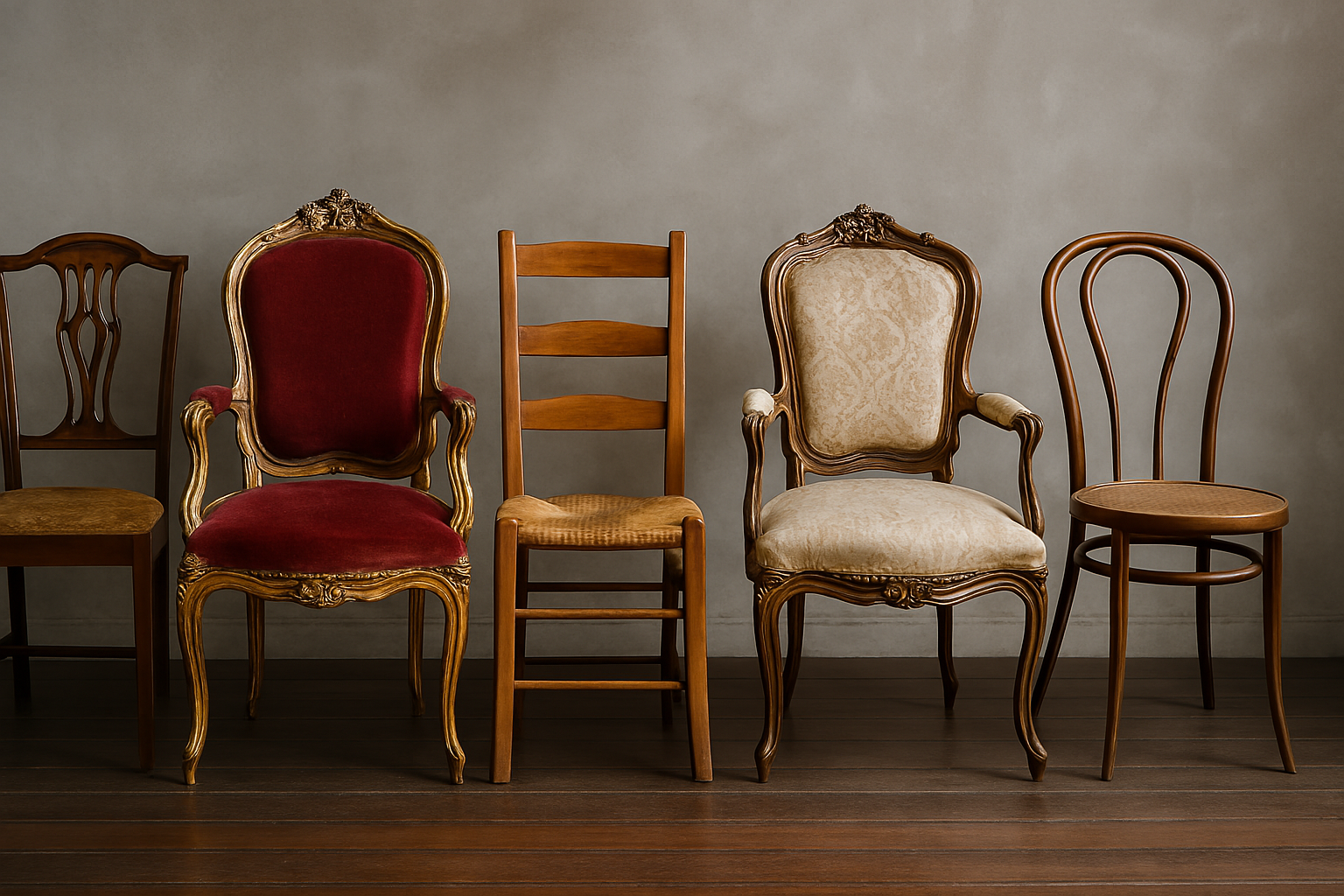
Integrating an antique piece into a modern setting is a subtle art, balancing intuition, courage, and harmony. Among all furnishings, antique chairs are some of the most versatile and striking elements to incorporate into a contemporary space. Lightweight, mobile, and discreet yet visually powerful, vintage chairs can transform an ordinary corner into a focal point full of style and character. But how do you harmoniously blend them with minimalist furniture, neutral walls, and modern atmospheres?
The first step is to overcome the fear of contrast. An antique piece doesn’t necessarily have to “match” the rest of the decor. In fact, its strength lies in being different, disrupting visual continuity, and creating a break that attracts the eye. A Louis XVI chair in gilded wood can stand out remarkably next to a desk in brushed steel. A rustic early 20th-century chair can add warmth to a kitchen with lacquered cabinets. The key is to enhance the piece, not overwhelm it.
One of the most effective strategies is the targeted use of a single chair as an “accent piece.” In a living room dominated by neutral tones and square lines, an antique chair, perhaps restored and reupholstered with a contrasting fabric, can become the focal point of the entire space. In an entryway, a baroque chair placed next to a modern mirror creates a sophisticated yet accessible visual effect. In the bedroom, an Empire-style chair can serve as a side table, but also as a chromatic echo if upholstered in tones consistent with the curtains or linens.
The game becomes even more interesting when using multiple different chairs, each with its own history, placed around a contemporary table. This trend, also known as mismatch or mix and match, creates lively, personal environments that reflect the eclectic story of the homeowner. Of course, harmony should still be sought: you can play with the color palette, material consistency (natural woods, similar upholstery), or a stylistic thread (all 20th-century chairs, or all rustic, but different in shape).
Another interesting approach is creative repurposing. An antique chair can be transformed into a nightstand, a base for a plant, or a support for a work of art. A pair of Art Nouveau chairs can frame a modern cabinet, creating a balanced visual composition. Even in bathrooms or hallways, vintage chairs can serve as a support or decorative element, provided they are well integrated and enhanced with the right lighting.
In some cases, restoration can become an opportunity for artistic reinterpretation. An old farmhouse chair can be painted in bright colors or upholstered with a contrasting contemporary fabric (such as a geometric or tropical print). If done with sensitivity, this operation does not distort the object’s identity but updates it. The key is to keep its original soul legible: the signs of time, the patina, the structure.
Finally, it’s important to remember that antique chairs carry an emotional history. Whether they come from a flea market, a family legacy, or a trip, they are objects that dialogue with the present but speak of the past. Incorporating them into a modern environment doesn’t just mean “decorating with style” but introducing a fragment of memory, a gesture of continuity, and an attention to beauty that withstands time into everyday life.
In an era dominated by standardization and mass production, every object with its own story is an antidote to emptiness. And chairs, with their lightness and dignity, are perfect for reminding us that true elegance comes from intelligent mixing, not uniform perfection.