

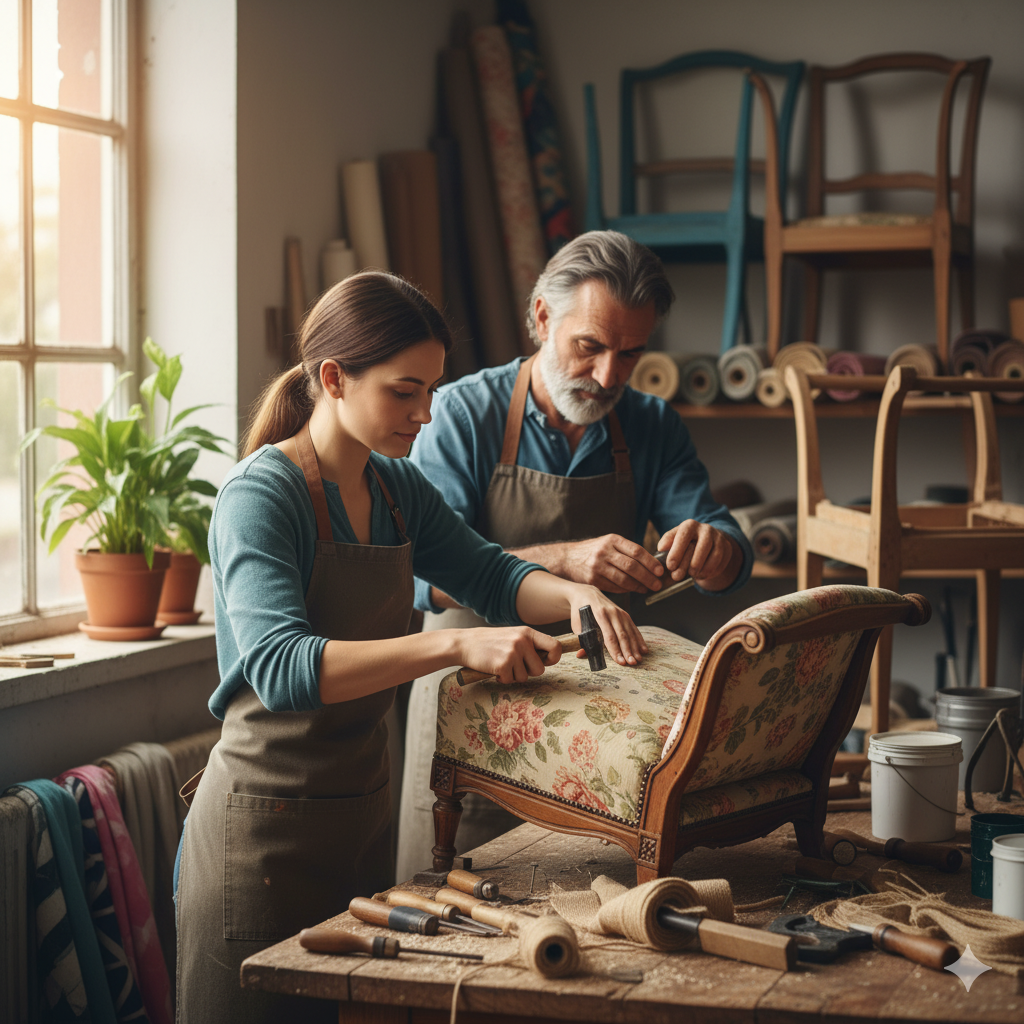
Chairs hold a special place in the world of antiques, possessing both charm and versatility. As silent witnesses to our daily lives, they have graced rooms and eras, never losing their primary purpose: to welcome, support, and invite us to pause. However, when an old chair ends up in a corner, perhaps with a wobbly leg or worn-out seat, we face a choice: let it go… or give it a fresh start. Restoring an antique chair is more than just a practical task; it’s an act of poetry. It’s a way to reconnect with the past and seamlessly integrate it into our contemporary spaces.
Restoring a chair requires care, method, and respect. Each piece tells a story of styles, functions, wear and tear, and materials. Before reaching for sandpaper or a brush, careful observation is key. What era does the chair belong to? Is it a simple, everyday seat, a piece of bourgeois parlor furniture, or a work chair? Is it made of walnut, oak, or beech? Does it have straw, leather, or fabric inserts? Is it painted, lacquered, or carved? Each detail influences the subsequent choices. The first step in any good restoration is precisely this: listen to the chair, understand what it wants to preserve, and what, if anything, needs to be renewed.
One of the first tasks is structural consolidation. Many old chairs have loose joints, compromised interlocking parts, and unstable legs. In these cases, modern PVA glue should be avoided; instead, opt for natural glues, such as rabbit-skin glue, or reinforced interlocking with wooden dowels, which respect the original constructive logic. Using clamps during gluing is crucial to maintain the correct proportions. If a part is missing (a slat, a leg, a spindle), it is always better to reconstruct it from a similar model, avoiding incongruous industrial materials.
Then there’s the surface to consider. A chair may have been painted, waxed, or varnished. If the surface layer is damaged, dull, or cracked, you can proceed with a gentle cleaning, using natural products or selective solvents. In many cases, a mixture of beeswax and turpentine is enough to restore shine to the wood. In others, especially if the chair has been poorly painted in recent times, controlled stripping may be necessary, being careful not to damage the original patina, which is part of its value.
One of the most fascinating aspects of restoration is regenerating the seat. If it’s a straw seat, you can opt for a new hand-woven seat, using Vienna straw or natural raffia, following traditional techniques. This work requires time, patience, and precision, but the result is unparalleled: a solid, comfortable, and beautiful seat. If, on the other hand, the chair has padding, you need to assess whether to preserve it, reupholster it, or redo it from scratch. Again, the choice of fabric is essential: it must respect the style of the era but also harmonize with the environment in which the chair will be placed.
The final color is a very delicate matter. An old chair can be left in its natural wood, enhanced by wax or transparent varnish, or it can be painted in more contemporary tones. In some cases, a coat of chalk paint, followed by targeted sanding, can create that “shabby chic” effect so appreciated in rustic or Provençal interiors. In others, color should be used sparingly, so as not to cover valuable details such as carvings or threads. Any chromatic intervention should be reversible and designed to complement, not disguise.
Restoring a chair is also an act of sustainability. In a world that tends to throw away and replace, choosing to recover means respecting materials, craftsmanship, and time. Every nail removed, every vein rediscovered, every scratch smoothed is a small victory against oblivion. The result is not just a recovered piece of furniture but an object that lives a second life, capable of speaking to the present with the authenticity of the past.
Finally, there’s the personal satisfaction. A hand-restored chair is never just a piece of furniture: it is a unique item, the result of an encounter between the person who built it and the person who wanted to save it. It looks good in the kitchen, in a reading corner, in front of a desk. It carries with it a story, a new identity, and often a poetic touch that no new object can ever imitate.