

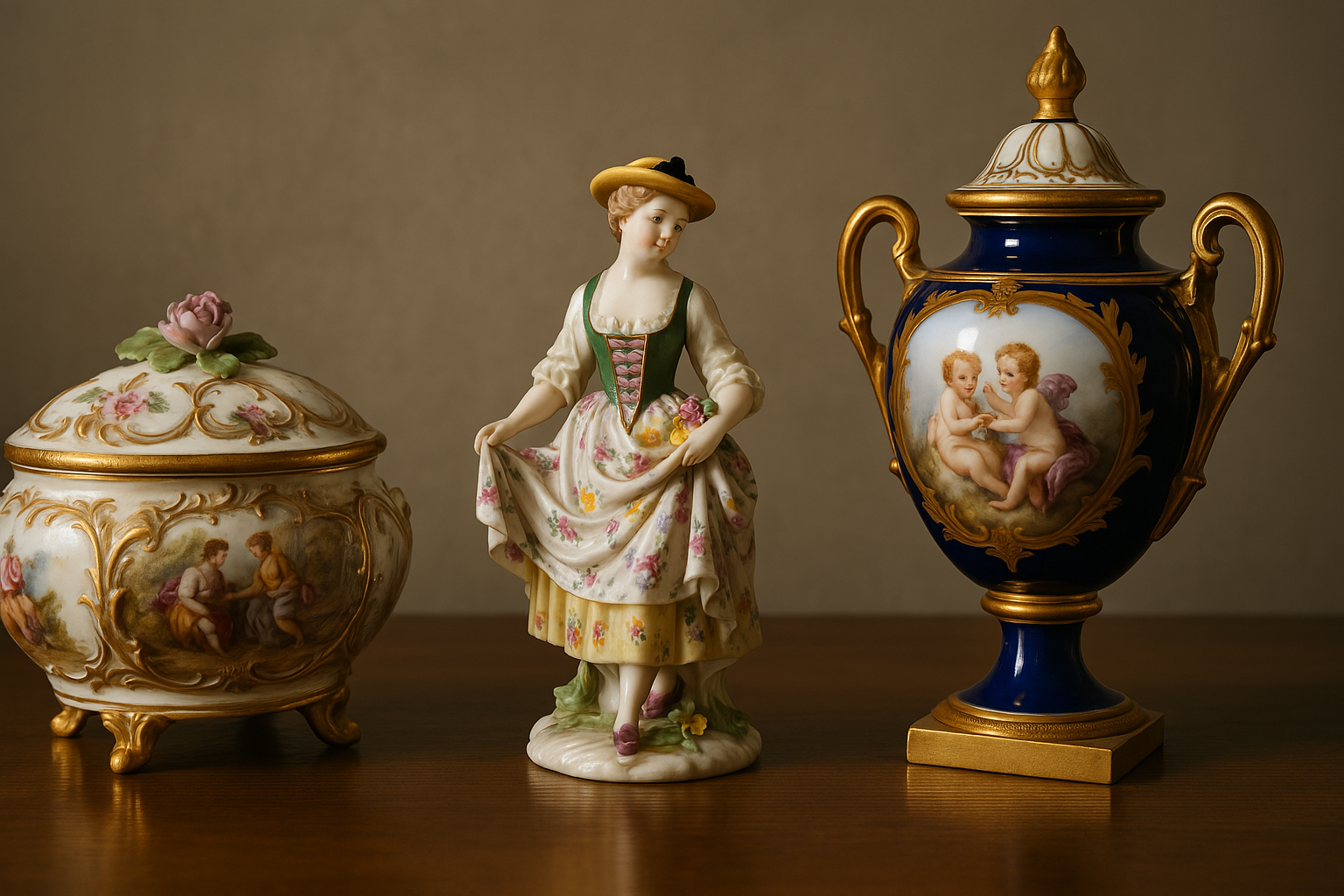
In the vast world of antique porcelain, some manufacturers stand out not only for their technical excellence but also for the aura surrounding them. Names like Meissen, Sèvres, and Capodimonte are not mere geographical references but historical hallmarks, evoking elegance, luxury, and, above all, a long tradition of artisanal perfection. However, recognizing them isn’t always easy. It requires a keen eye, study, and, above all, a deep knowledge of the distinctive markings each manufacturer has left on their pieces. This article is designed for those who want to learn to distinguish not just “a beautiful porcelain,” but a piece of high-quality manufacture.
Let’s start with Meissen, the first European hard-paste porcelain factory, founded in the early 18th century in Saxony. Its oldest pieces – those produced until the mid-1700s – are among the most coveted by collectors worldwide today. The unmistakable mark with the two crossed swords, hand-painted under the blue glaze, is the first detail to look for, but be careful: the mark has been imitated many times over the years. Therefore, the symbol alone is not enough. Genuine Meissen pieces exhibit a silky finish, a delicate yet profound chromatic rendering, and, above all, an extremely precise modeling, in which every figure, flower, fold, or decoration is crafted with an extraordinary sense of form.
There are technical characteristics to observe. Meissen is distinguished by the compactness of the paste, the controlled translucency of the porcelain, and the precision of the design. In particular, the figurative pieces – statuettes, sculptural groups, decorative elements – are a privileged ground for assessing quality: the face of a lady, the rendering of a drapery, the naturalness of a gesture are all clues of authenticity and high level. Other distinctive signals are the model numbers engraved or impressed on the base, which allow tracing back to the official catalog of the manufacturer.
Moving on to Sèvres porcelain, we find ourselves in a context deeply linked to French history. Founded in 1740, and moved to Sèvres in 1756 under the protection of King Louis XV, this manufacturer soon became synonymous with prestige and innovation. Sèvres porcelain is known for the extraordinary quality of the glaze, the use of famous background colors such as “bleu céleste,” the “rose Pompadour,” or deep turquoise, and for the refinement of the painted miniatures. Each piece is a microcosm of elegance, curated down to the smallest details.
To recognize an authentic piece of Sèvres, in addition to the evident quality of the painting, it is essential to observe the mark, generally formed by two interlaced letters (indicating the year of production), often accompanied by a royal crown or additional letters indicating the painter, gilder, or enameler. The porcelain has a compact consistency, with smooth surfaces and soft curves. Attention to detail is found not only in the decoration but also in the edges, bases, and gilded bronze fittings, often present in the more elaborate pieces.
Finally, Capodimonte, Italian pride and one of the most fascinating manufacturers in terms of style and history. Founded in 1743 in Naples by Charles of Bourbon, the manufacturer immediately distinguished itself for the production of soft-paste porcelains, of Rococo inspiration, but with a strong Mediterranean personality. The oldest Capodimonte pieces are recognizable by the particular brilliance of the glaze, the vivid colors, and especially for the “pictorial” modeling of the scenes: mythological groups, pastoral figurines, floral decorations in relief.
The original mark was a crowned N painted in blue under the glaze, but here too caution is required: the mark has been used by numerous subsequent factories, often without direct links to the original. To distinguish historical porcelains from more recent ones (and very widespread), one must observe the complexity of the modeling, the pictorial rendering of the faces, and the stylistic coherence. The true eighteenth-century Capodimonte pieces have a delicacy that cannot be improvised.
All these manufacturers share an essential characteristic: quality as an identifying sign. Those who work porcelain at these levels leave nothing to chance: every brushstroke, every relief, every small mark on the base tells of a highly specialized production chain, where painters, sculptors, enamelers, and gilders collaborate to create unique objects. Even imperfections, if present, are consistent with the technique and the era, never accidental.
For the collector, knowing how to recognize these elements is not only an economic advantage but also a form of respect for the history of the object. Behind each authentic piece are stories of court, royal commissions, and artists often remained anonymous but possessed extraordinary talent. Learning to distinguish the true from the false, the high from the middle level, means entering into a deeper relationship with the piece, appreciating not only its aesthetics but also the material culture it represents.