

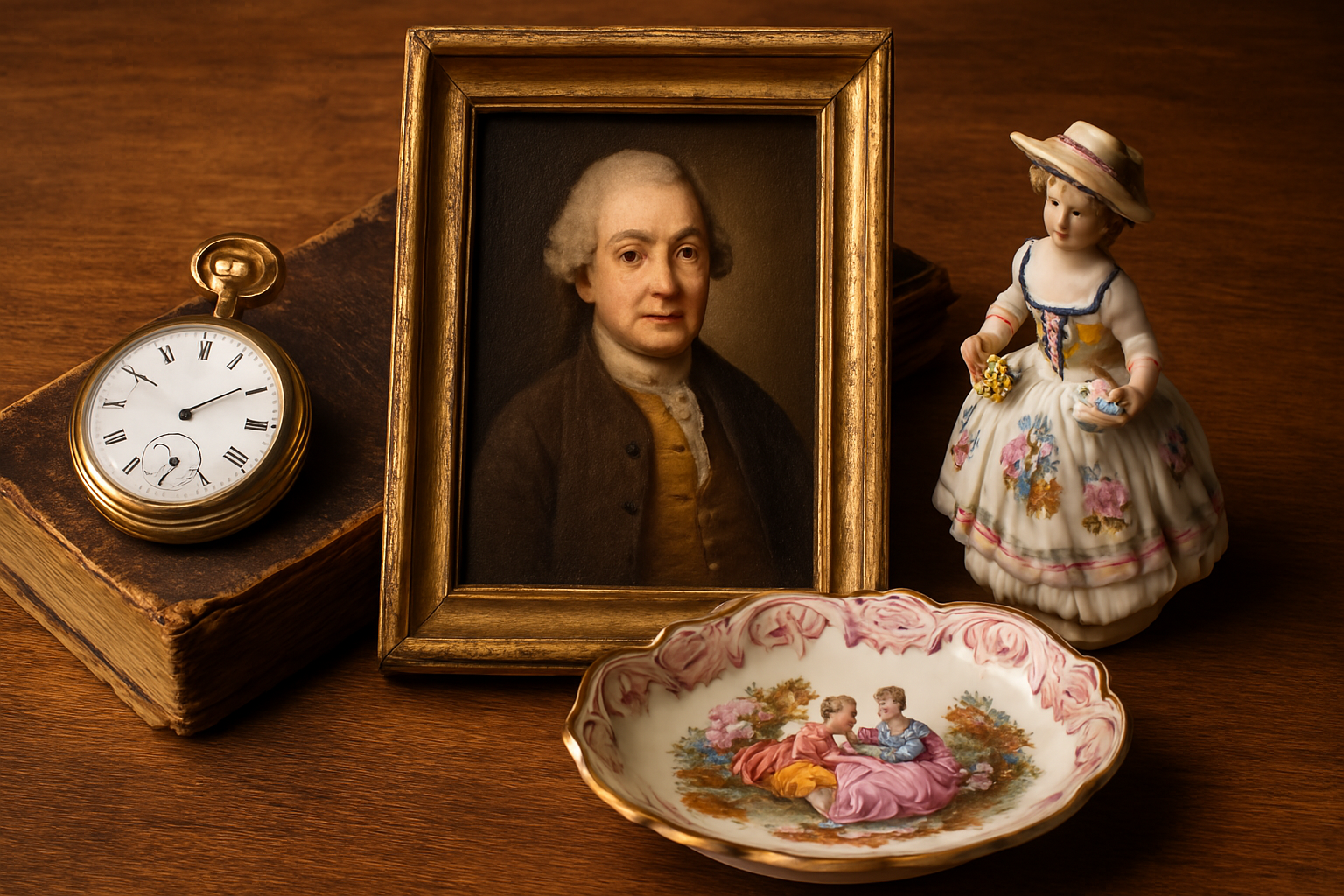
In the world of antiques and collecting, sometimes it’s the mistake—or rather, the apparent mistake—that makes all the difference between a simple expense and a memorable discovery. There are stories where an inexperienced buyer accidentally purchased something, convinced it was a copy, a common item, or a simple decorative piece… only to discover they had a rare, authentic, sometimes even museum-worthy item in their hands.
These episodes are not urban legends but documented cases, fascinating because they challenge the principle that only experts can recognize value. In reality, the history of antiques is full of ‘lucky breaks,’ where intuition, chance, or curiosity triumphed over expertise.
One of the best-known cases is that of a man who, in a London flea market, bought a small 19th-century style painting for around twenty pounds, thinking it was a living room reproduction. After some time, he showed it to a restorer friend, who suggested cleaning it gently. Under the layer of yellowed varnish, the authentic signature of J.M.W. Turner, one of the greatest English painters, emerged. The painting, believed to be lost, was valued at over £300,000.
Another extraordinary story comes from New York: a woman bought an amber necklace in a vintage store, attracted by the intense color of the stones and the silver setting. The price was modest, around $40. A few months later, during an event at a natural history museum, she noticed a very similar necklace in a display case. Intrigued, she had hers analyzed: it was prehistoric Baltic amber, dating back over 4,000 years. The object, probably part of an old, dispersed collection, is now preserved as an ethnographic artifact.
There are also examples in the world of books. A young man bought a leather-bound volume without a dust jacket at a used book fair, thinking it was a school copy of some English author. In reality, it was an American first edition of ‘The Great Gatsby’ from 1925, recognizable by a printing error on the third line of page 205, corrected only in subsequent reprints. The value? Over $100,000 at auction.
Coins and banknotes are also subject to similar discoveries. Certain minting or printing errors, ignored for years, are now among the most sought-after pieces by numismatists. A novice collector purchased a coin from the Kingdom of Italy on an online site for about ten euros. Only after the purchase did he realize that the reverse was printed upside down compared to the obverse, a very rare defect known as ‘axis errors,’ which exponentially multiplies the value. He resold it at an auction house for 15,000 euros.
But it’s not just about money. Sometimes, what is gained is a story, an emotional connection, a cultural identity. A woman bought an old diary with writings in French at a flea market. Reading it, she discovered it belonged to a young Jewish girl who lived in Paris during the Nazi occupation. Through the diary, she reconstructed the girl’s entire family history, even managing to track down some surviving descendants. Today, that diary is displayed in a documentation center on Holocaust remembrance.
All these stories remind us that we don’t always know what we’re buying. And that’s not necessarily a bad thing. Sometimes it’s the mistake, the impulse purchase, the hasty judgment that leads us to surprising discoveries. Because value, in antiques as in life, is not always where we expect to find it.
Anyone who frequents flea markets, fairs, auctions, or thrift stores should always remember this: look closely, don’t trust appearances alone, listen to your instincts. And above all, never underestimate anything just because it ‘seems’ unimportant.
Because sometimes, the real treasure is precisely what we chose… by mistake.