

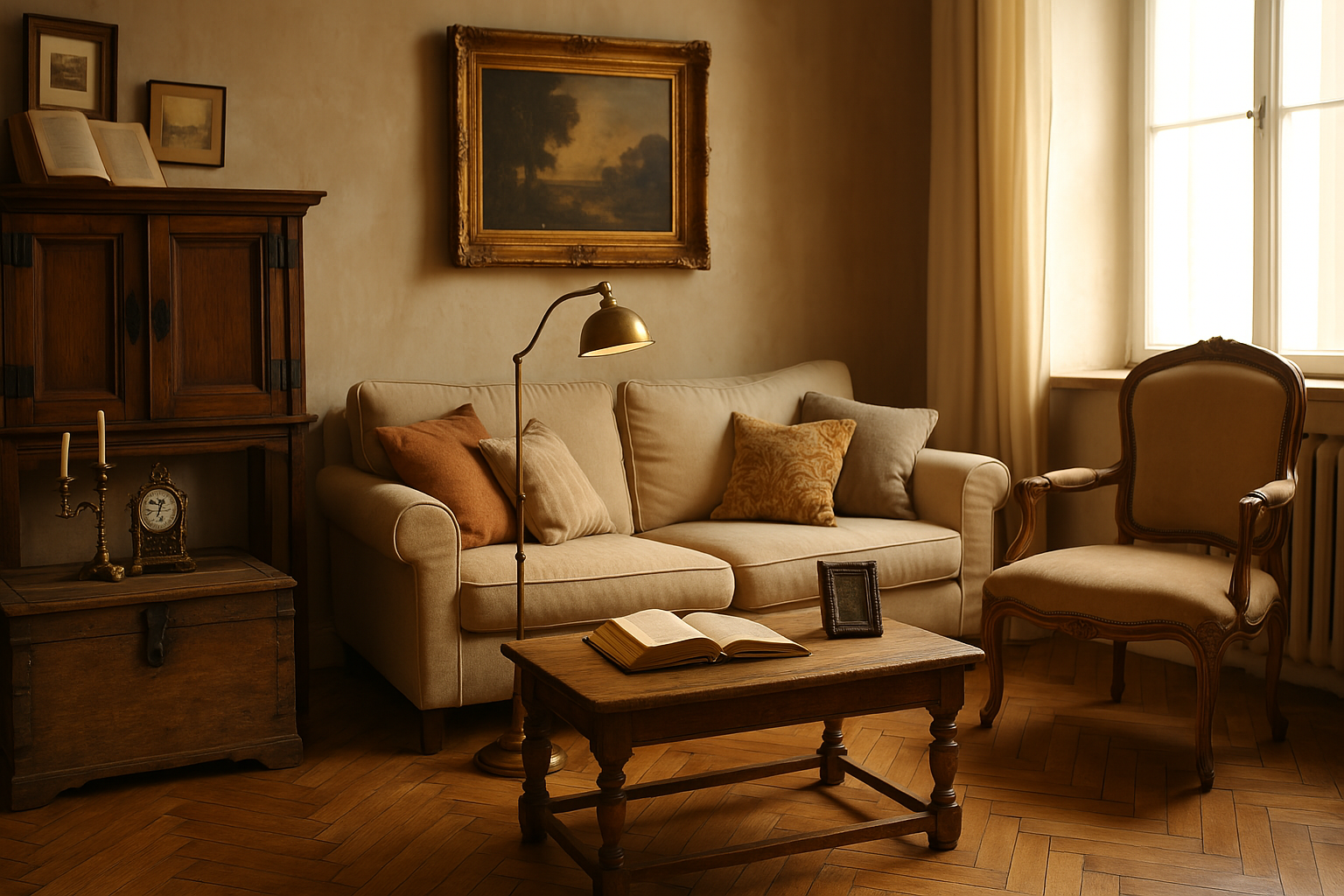
Returning home, treasure in tow, from an antiques market fills you with a unique sense of accomplishment. These aren’t merely purchases; they’re discoveries, conquests, tangible mementos that have somehow chosen you. Yet, once you’ve crossed your threshold, a question often arises: where and how do I integrate this without disrupting the harmony of my space? How can I ensure that walnut side table, gilded frame, or vintage brass lamp truly speaks to what already inhabits my home?
Integrating antiques into contemporary settings is a nuanced art. It demands sensitivity, care, and a willingness to see your space with fresh eyes. An antique object, by its very nature, carries a strong presence, recounting an era, a style, a taste often removed from the modern. But within this very distance lies its expressive power. The secret lies in embracing it, not forcing it to blend in.
The first rule, if you can call it that, is to listen to the object. Observe it, understand its proportions, colors, and original function. Many antique pieces were created for a specific purpose – a blanket chest for linens, a dressing table mirror, a kitchen plate rack – but today, they can be reinterpreted freely. An antique workbench can become a unique entryway console, a tailor’s table can transform into a writing desk, a sideboard can become a vanity base in a contemporary bathroom.
The key is not to replicate a period style, but to create a dialogue between past and present. An antique piece doesn’t necessarily need to be surrounded by items from the same era. In fact, it often stands out more when placed in a minimalist, modern setting with neutral walls, streamlined furniture, and natural materials. A single striking piece, well-placed, can become the visual heart of a room, capable of adding depth and personality even to the most understated space.
Another crucial aspect is lighting. Antiques respond to light quite differently than modern industrial materials. The crafted surfaces, dark woods, and oxidized metals create plays of shadow and reflection that deserve to be celebrated. Proper lighting, whether natural or artificial, can completely transform an object’s perception. Proximity to other materials – stone, linen, coarse cotton, glass – can also amplify an antique’s beauty, highlighting its textures and details.
Ultimately, it’s not the economic value of the object that counts, but the narrative value it can bring to your home. An antiques market is a treasure trove of stories; each chosen object has a past that deserves to be welcomed, integrated, perhaps even recounted. You don’t need to “decorate in style” to appreciate its presence. Simply create a space where the piece can breathe, without being suffocated or made a fake protagonist.
In many cases, it can also be helpful to think of the object as a starting point. Sometimes, a single piece can suggest a small transformation of the environment: a change of layout, a combination of colors, a different functional organization. An old wardrobe, for example, may require moving the bed; a large framed print may redefine the visual center of a room. Welcoming an antique object ultimately means being willing to question ourselves as inhabitants of the space.
And finally, there’s one last aspect, perhaps the most important. When an antique object enters our home, it also enters the flow of our daily lives. It’s no longer just “antique,” it’s ours. It begins to dialogue with the present, to enter our habits, to slowly change with us. Perhaps it will wear a little, perhaps it will undergo a small restoration, perhaps it will change rooms several times. But it will remain a silent witness to the passage of time, with that discreet strength that only things lived can express.
Integrating an object found in an antiques market is, ultimately, a gesture of reconciliation between memory and modernity. It’s a way of saying that what has been is not lost, but can still speak, with new accents, in the homes of today.