

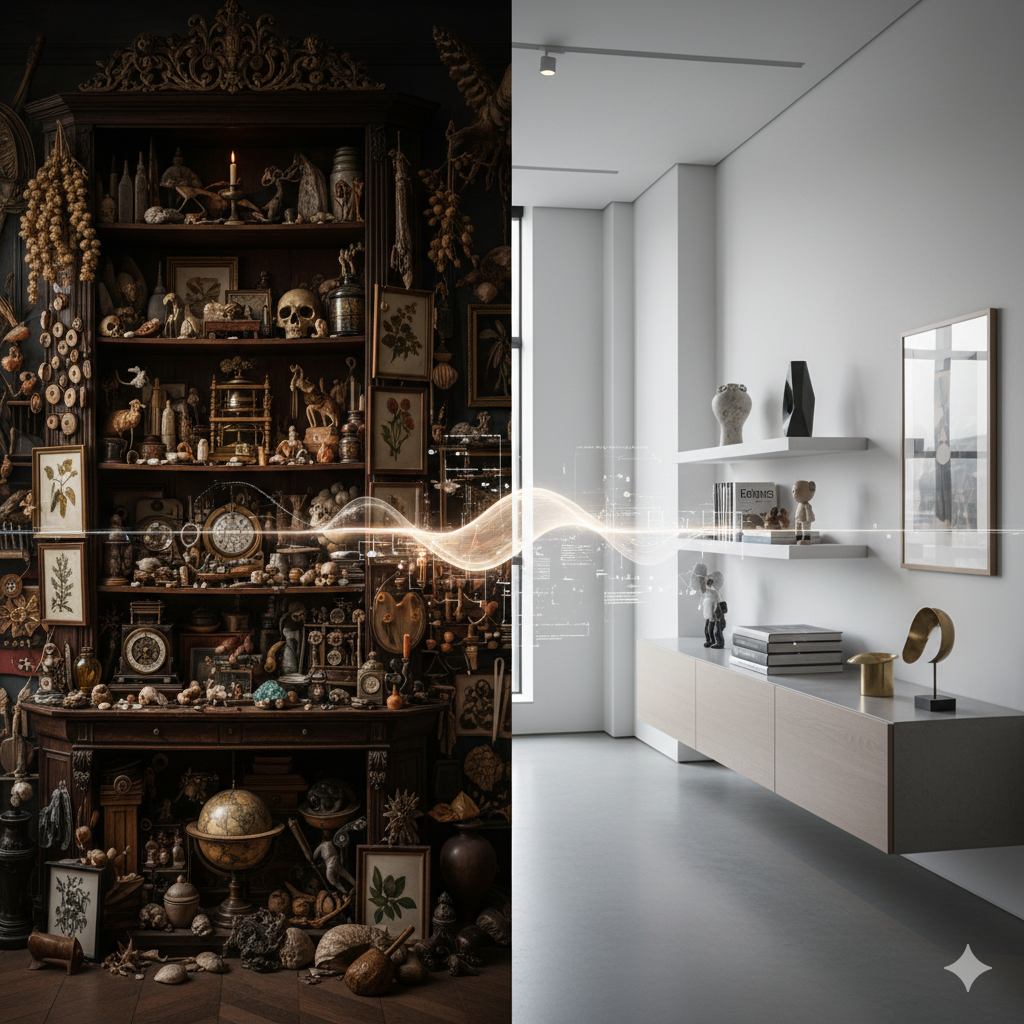
Collecting, even before becoming a structured practice, was a primal urge: the desire to possess, organize, contemplate. But it’s also a profound cultural reflection, changing with time, adapting to eras, reflecting worldviews. Tracing the history of collecting, from the marvelous Wunderkammer of the Renaissance to the curated collections of contemporary interiors, means tracing a map of our relationship with knowledge, beauty, and possession.
The Wunderkammer: Collecting as Wonder
In the 16th and 17th centuries, the so-called cabinets of curiosities (in German, Wunderkammer) emerged among European courts, predecessors of museums. They were not collections arranged according to scientific criteria, but fascinating and theatrical environments where natural and artificial objects coexisted, along with exotic artifacts, works of art, fossils, measuring instruments, minerals, and stuffed animals. Everything rare, unusual, or inexplicable found a place in these rooms.
The collecting of the Wunderkammer era reflected an encyclopedic and wondrous view of the world. It was a way to dominate the unknown, to assert the intellectual and social power of the collector. And at the same time, it was a journey through time and space: each object carried with it a story, a mystery, a reminder of distant lands or forgotten eras.
The 19th Century: The Age of Order and Classification
With the Enlightenment and Positivism, collecting changed its face. Private collections began to take on a scientific, systematic character. Natural history cabinets, numismatic collections, and art collections organized by schools and genres emerged. The collector no longer sought only wonder but knowledge: they wanted to date, compare, describe. The concept of restoration, conservation, and enhancement also developed.
It was during this period that many private collections were transformed into public museums or became founding cores of cultural institutions. Collecting became part of bourgeois identity: possessing and displaying art objects or antiquities was a way to assert taste, education, and status.
The 20th Century: The Burst of Aesthetics and Identity
During the 20th century, collecting opened itself to new sensibilities. Alongside historical or scientific collections, thematic, emotional, and artistic ones emerged. Some collected advertising posters, some dolls, some Arte Povera, some industrial design objects. The value was no longer (just) historical but emotional, aesthetic, cultural. The collection became a personal narrative.
With the birth of modern interior design, collecting also entered the home. Objects were no longer locked away in display cases but interacted with the space, becoming part of the decor, participating in domestic identity. The collector was no longer just a preserver but also a visual storyteller, a curator of their everyday life.
Today: Collecting Between Memory and Minimalism
In the 21st century, collecting faces a fascinating paradox. On the one hand, we are immersed in a digital and dematerialized culture, where everything is archived in the cloud and physical goods seem superfluous. On the other hand, the need for tangibility, authenticity, and uniqueness is growing. Young collectors seek pieces that speak of themselves, that tell stories, that are not standardized.
At the same time, contemporary living space is often minimalist. This imposes a new form of collecting, more selective, curated, and expressive. One does not accumulate; one chooses. One does not display everything; one sets up, constructs a visual narrative in harmony with the environment. Collections become smaller but denser in meaning. Ecology also plays a role: collecting means reusing, preserving, rescuing from oblivion and waste.
The journey from the Wunderkammer to contemporary design is, in essence, the journey of our culture. From a wondrous vision to a rational vision, from an act of possession to a narrative gesture. But in every form, collecting remains a profound act of love for what has been, for what endures, for what – through objects – continues to speak.