

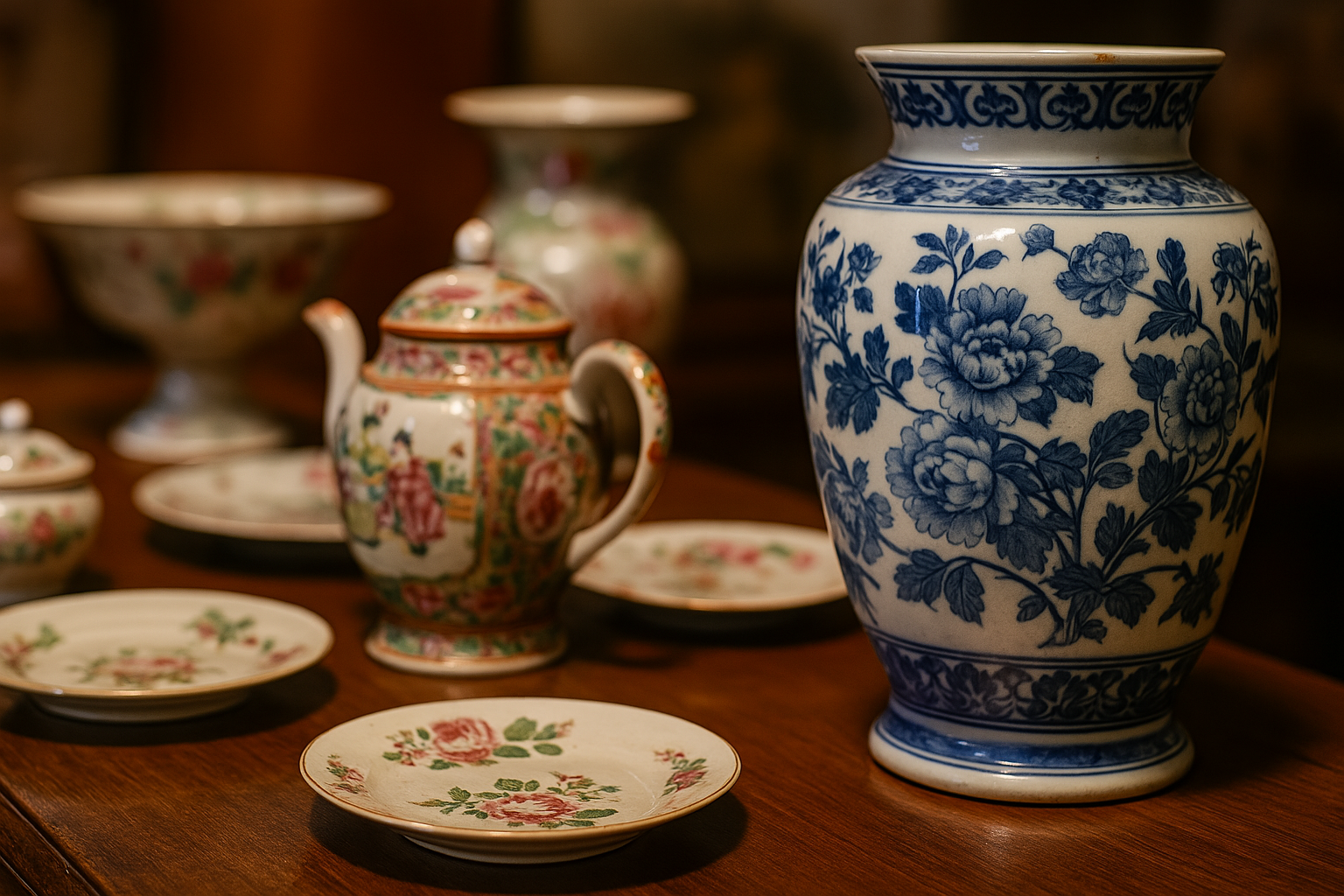
The antique porcelain market has always been one of the most fascinating and complex realms in the world of antiques. These refined, fragile, and precious objects possess the ability to transcend centuries, retaining their charm and, in some cases, increasing enormously in value. However, these very characteristics also make porcelains among the most susceptible items to counterfeiting, partial reconstructions, underestimations, or inflated sales. Navigating this universe requires not only an appreciation for aesthetics but also a solid understanding of the market, its dynamics, and its pitfalls.
In recent decades, the value of antique porcelains has experienced significant fluctuations. While the 1980s and 1990s saw a rush to collect complete sets, figurines, and decorative objects, today the market has become more refined, polarizing between high-end manufacturing pieces – highly sought after and expensive – and more common items, often found in flea markets or smaller auctions at affordable prices. However, this apparent duality hides a wide variety of situations: there are rare porcelains that go unnoticed, and common pieces sold as precious.
One of the most frequent mistakes, in fact, is confusing aesthetic beauty with historical and collectible value. A porcelain may be aesthetically pleasing but lack a signature, recognizable mark, or documentation, making it difficult to trade at a high price. Conversely, a small plate with an apparently modest decoration but with a rare mark, precise dating, and certified provenance can fetch very high figures. In this sense, experience and critical reading skills are essential.
The informed collector knows that there are reference manufacturers whose pieces are always sought after: Meissen, Sèvres, Capodimonte, as well as Wedgwood, Vienna, Herend, Worcester. Their marks – if original – constitute a guarantee, but beware: they are among the most copied in the world. There are entire productions, even from the 20th century, that faithfully imitate decorations, colors, motifs, and even stamps. Some are declared copies, others are not. And this is where the problems begin.
Falsifications in the field of porcelain are as subtle as they are insidious. In many cases, it is not a question of genuine fakes but of “deceptive restorations”: pieces reassembled with fragments from different eras, modern glazes on antique bases, decorations repainted to mask wear and tear. A 19th-century figurine may have been beheaded and reconstructed with a modern head, then repainted to make the whole uniform. The result is a visually convincing object, but one that has lost all collectible value.
Another frequent case is that of “re-marked” porcelains: objects without a mark, or produced in minor factories, to which a fictitious or imitation mark is affixed. In some cases, the mark is applied cold, with decals; in others, it is hand-painted with modern techniques, but simulating old styles. The careful collector learns to recognize these details: the intensity of the blue, the position of the mark, the quality of the enamel, the micro-scratches of firing, the texture of the edge.
To avoid scams, it is essential to buy from reliable sources. The most reputable auction houses offer detailed information sheets, comparative analyses, and estimates consistent with the international market. The best antique dealers, in addition to providing guarantees, often share the history of the piece, its origin, and in some cases the bibliography in which it has been published. Flea markets and fairs remain wonderful places to find bargains, but you have to go there prepared, with a critical eye and simple but effective tools: a lens, a portable light, a few reference photos.
Today, digitization has opened up new possibilities. Many collectors follow online auctions, where it is possible to compare hundreds of pieces from all over the world. Here too, however, caution is necessary: photos do not always reveal imperfections, restorations, or chromatic alterations. And above all, the impossibility of touching the object greatly limits its evaluation.
Among the pieces to keep an eye on in the current market are:
- 18th-century Meissen and Sèvres figurines in excellent condition;
- Chinese porcelains from the Qing dynasties, especially with blue and white decorations;
- Complete tea and coffee services with historical marks and personalized decorations;
- Limited editions from famous manufacturers, especially from the early 20th century;
- Pieces decorated by hand with historical or mythological subjects.
Even in the mid-range, there are many opportunities. Liberty cups, Art Deco plates, Neoclassical figures by Wedgwood, or floral Capodimonte pedestals from the second half of the 19th century can be purchased at reasonable prices and, if in good condition, retain good aesthetic and collectible value.
In conclusion, the antique porcelain market is still rich, vital, and surprising today. But it must be approached with respect, knowledge, and a good dose of caution. Because every authentic piece is a fragment of beauty that has survived time. And knowing how to recognize it, amidst a thousand imitations, is an art that deserves to be cultivated.