

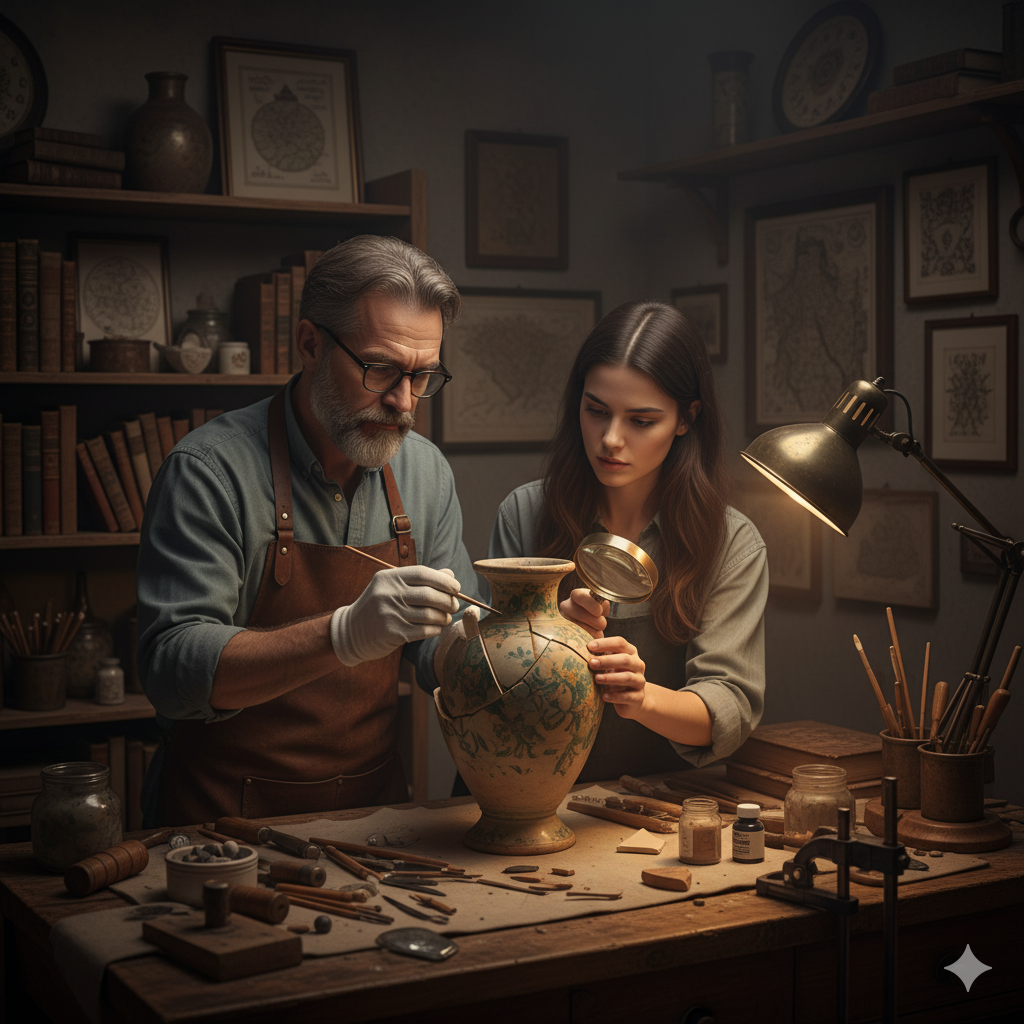
Restoring an antique is a delicate act, a sort of surgery on a fragment of history. It’s not merely about “making something old look new again” but about operating with awareness on material testaments to the past, respecting their identity, integrity, and the patina of time. Every intervention on an antique artifact can restore its life and function, or—if poorly executed—irreparably compromise its historical, aesthetic, and economic value.
In the world of antiques, the line between restoration, conservation, and alteration is often thin. Intervening on furniture, a pendulum clock, a gilded frame, a wooden sculpture, or an antique canvas requires not only technical competence but, above all, a respectful attitude. And the first true responsibility lies with the owner of the object: the collector, the heir, the enthusiast.
Knowing When to Intervene: Conservation Doesn’t Mean Ignoring
Not all antiques need restoration. In many cases, the simple fact that an object shows signs of age—small cracks, light oxidation, surface abrasions—doesn’t mean it’s “ruined.” On the contrary, what is called patina, i.e., the set of superficial changes that time imprints on materials like wood, metal, fabric, or ceramics, is an element of value. Removing it is like erasing a part of its history.
Restoration should only be considered when the object has structural damage, compromised functions (in the case of mechanical objects), or conditions that could worsen over time: infestations, active degradation, recent fractures. In all other cases, it’s preferable to adopt a conservative approach, which aims at stabilizing the object rather than transforming it.
The Importance of Knowing Original Materials and Techniques
Each era and geographical area used different construction materials and techniques. Intervening without knowing the object’s history means risking incompatible interventions. For example, many Italian 18th-century furniture pieces used organic glues and natural varnishes based on shellac, while the 20th century saw the introduction of synthetic adhesives and industrial paints. Applying modern materials to antique surfaces can cause chemical alterations, discoloration, detachment, or deformation.
For this reason, before even thinking about restoration, it’s essential to recognize the object for what it is: date its era, understand its origin, read any signs of production (signatures, hallmarks, labels), and compare it with similar pieces. Only then can you decide if and how to intervene, and especially whom to entrust it to.
Recognizing a Restoration Done Well (or Poorly)
A good restoration is recognizable because it is invisible. The intervention should harmonize with the object, respecting its style, material, and color. Conversely, when you notice coarse overlays, glossy paints on matte surfaces, visibly added or modified pieces, it’s likely a poorly done or, worse, invasive restoration.
Also, beware of “masked” restorations during the sale. Unfortunately, it happens that restored objects are sold as complete, without declaring the interventions they have undergone. Recent paints, replaced woods, redone inlays can increase the visual impact at the expense of authenticity. For this reason, it’s helpful to learn how to recognize the original surfaces, observe differences in wear, compare the grain, and the joints.
Relying on Professionals, Not Amateurs
The restoration of an antique object must be entrusted to experienced hands, with specific training and preferably with documentable experience. It is not enough to know how to “repair furniture” or “clean bronze.” It takes interdisciplinary skills ranging from the chemistry of materials to art history, from knowledge of pigments to period woodworking techniques.
A good restorer is not only able to intervene delicately but also provides documentation of the work performed: before and after photographs, technical report, materials used. This kind of transparency is a sign of professionalism and adds value to the object over time.
Reversible and Conservative Restoration
Among the fundamental principles of modern restoration is that of reversibility: any intervention should be able to be canceled or removed without damaging the original object. For example, a filler made with compatible and non-invasive materials can be removed in the future, if necessary. The same applies to light coatings or temporary bonding. This approach is fundamental when working on objects of historical or museum value, but it is always desirable even in private collecting.
A Dialogue Between Eras
Restoring, after all, is a dialogue between present and past. It’s a gesture that, when well conducted, allows the object to still tell its story, keeping intact the voice with which it did so a century or two ago. When you choose to intervene, you do so to preserve memory, not to erase it. And every choice—from the smallest cleaning to the replacement of a missing fragment—must be made with slowness, attention, and humility.
In a world accustomed to rapid replacement and smooth aesthetics, knowing how to recognize and respect the imperfection of the antique is a counter-current, almost revolutionary act. But it’s also a profoundly human act. Because restoring without damaging means understanding that time is an integral part of beauty.