

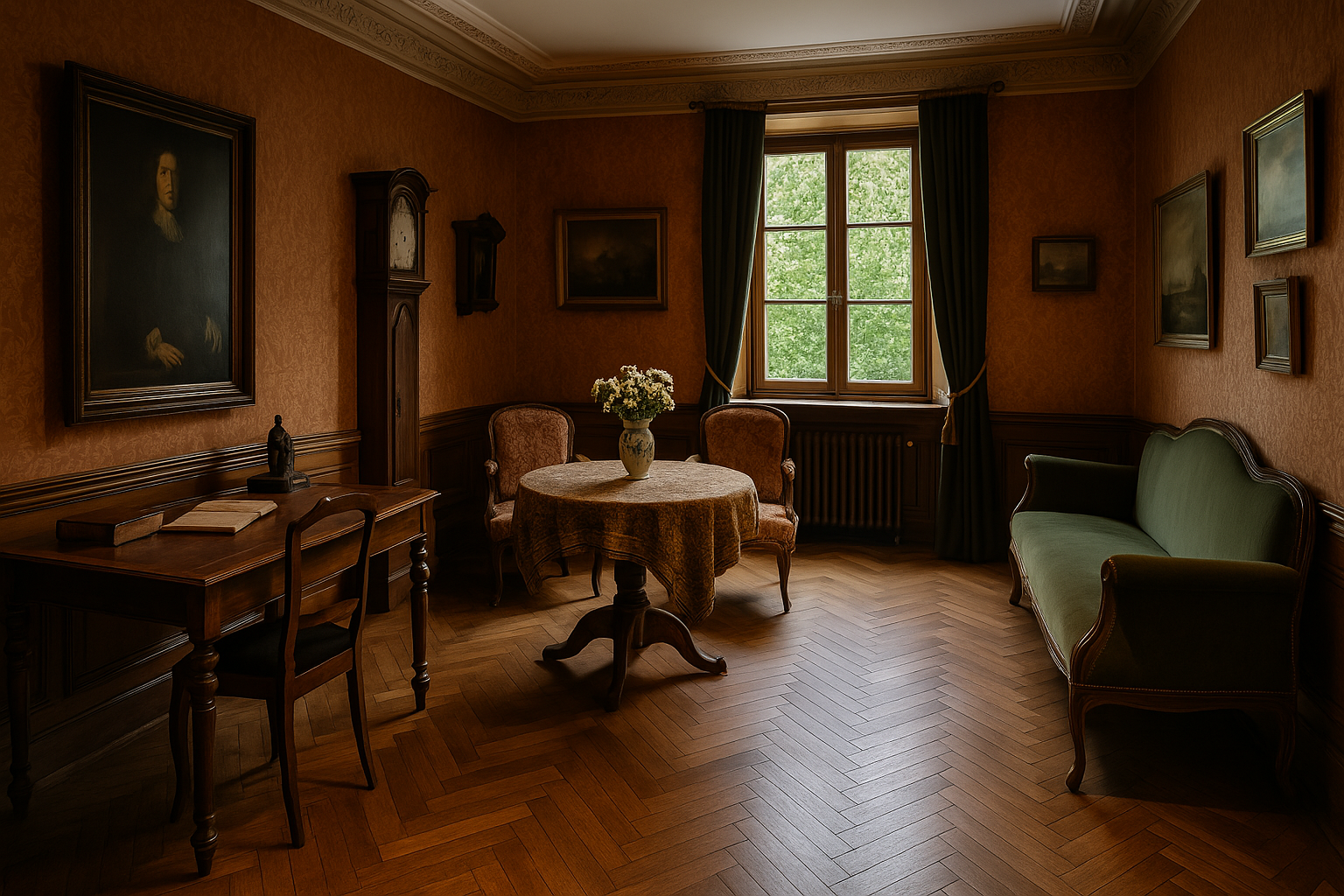
Entering a historic house museum isn’t just a visit to a museum with furnished rooms; it’s crossing an invisible threshold that separates the present from the past. You find yourself immersed in a time that no longer belongs to you, yet still breathes through the furniture, objects, light, and silence of those spaces. Europe’s historic homes offer something no other museum can: a complete emotional and sensory experience, a silent narrative woven from matter and memory.
Walking through the rooms of an 18th-century villa, observing the details of a carved console, feeling the weight of a damask curtain, or the dark patina of a bookcase lined with antique volumes allows you to understand the very concept of living in another era in an authentic way. These homes don’t just speak of aesthetics but of habits, daily life, and social relationships. Each object, each spatial arrangement, reflects a hierarchy, a code of conduct, an idea of intimacy very different from our own.
In the heart of Europe, many house museums reveal these hidden dimensions. Consider, for example, Maison de Victor Hugo in Paris: more than a house, it’s a psychological portrait of the artist. The arrangement of the rooms, the oriental furniture, the paintings, the manuscripts, all tell of his vision of the world, his inner self, his perspective on reality. Similarly, Palazzo Davanzati in Florence showcases the evolution of living between the Middle Ages and the Renaissance: a surprisingly modern environment in its concept of comfort and safety, with frescoed rooms and unexpectedly functional bathrooms.
But it’s not just about observing. Living in these houses, even just for the duration of a visit, teaches us something about our relationship with objects. In an age dominated by fast consumption and mass production, seeing how a table was built to last for centuries, how each element had a value and a meaning, prompts a profound reflection on the very concept of home.
Yet, what truly makes these experiences unique is the invisible layering of time. House museums are suspended places where the present coexists with the past in an intimate encounter. The creaking floors, the slightly wavy glass panes, the hand-sewn seams are details that give us back a tangible sense of humanity. It’s not just about style or art history but about empathy for those who lived before us, a silent dialogue between generations.
These houses are not mere containers of objects; they are living testimonies, and visiting one means enriching oneself with a lesson that no textbook can teach. Historic homes remind us that the past is never entirely past; it continues to speak, if we have the patience to listen.