

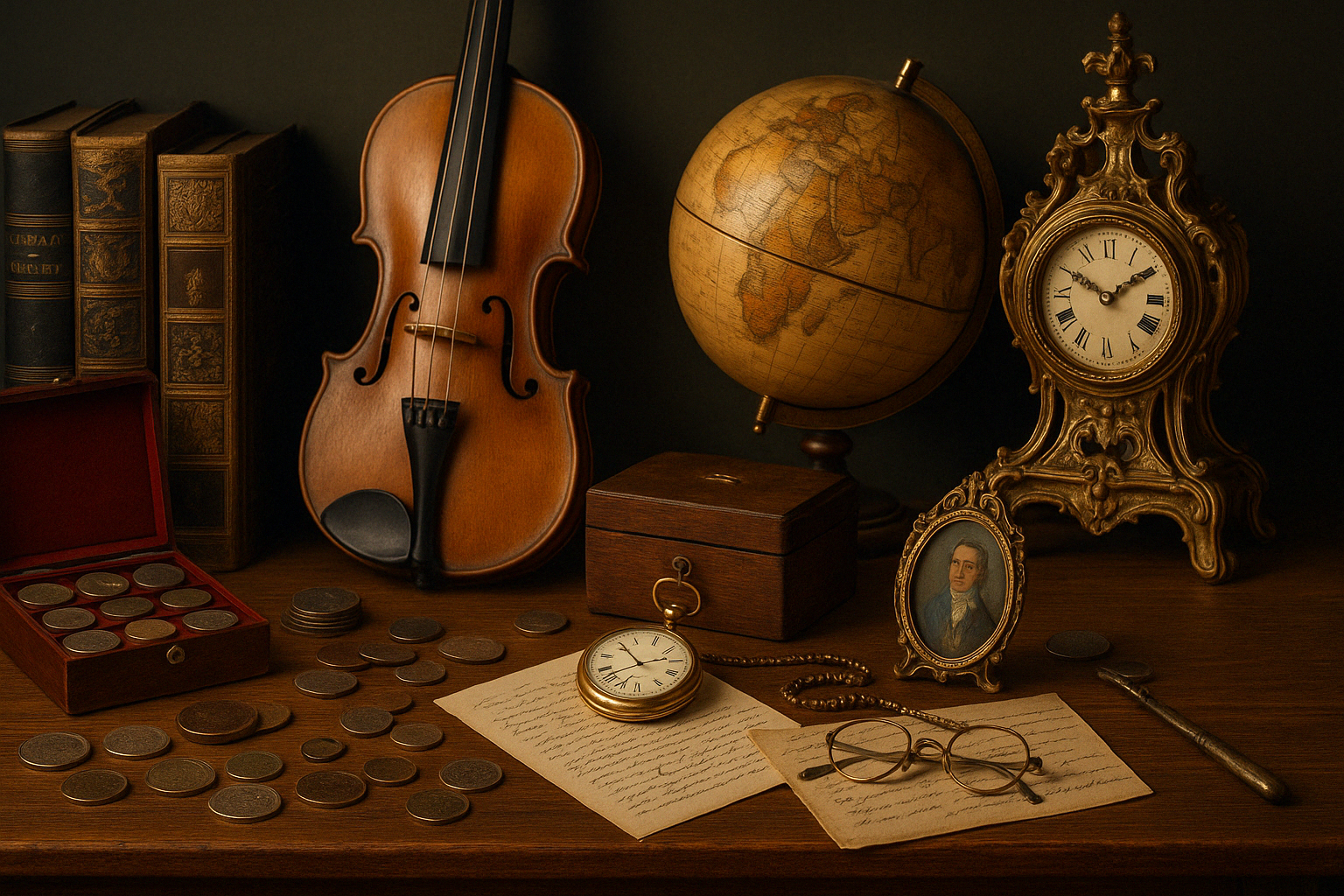
Collecting is more than just a hobby; it’s a mindset, a way of viewing the world, and a lens through which to observe time, memory, and value. For centuries, humans have gathered objects—not merely to possess them, but to study, preserve, and tell stories. Behind every collection lies a personal narrative, often intertwined with significant historical events. Each collected item is not only a witness to the past but also a reflection of the present: the collector’s taste, the market forces at play, and the attributed value.
The Origins of Collecting: Between Wonder and Knowledge
Collecting has ancient roots, with monarchs, princes, and popes creating ‘Cabinets of Wonders’ (Wunderkammern) filled with fossils, shells, scientific instruments, sacred art, and exotic artifacts. These collections lacked strict organization; they were encyclopedic and fascinating compilations born from curiosity, amazement, and a desire to own anything rare or extraordinary.
With the Enlightenment, collecting evolved. Collections became organized by themes, eras, schools, and styles. Museums, libraries, and public archives emerged. Private collectors also began documenting, classifying, and preserving. Collecting transformed into an intellectual pursuit, a form of knowledge. Collectors sought not just personal gratification, but also to reconstruct the past and transmit a heritage.
The Passion That Drives the Act
Behind every collection is an intuition, an emotional connection, an initial spark. Some start collecting as a game, others through family inheritance, and still others out of a love for beauty or history. Passion is the primary driver: the true collector doesn’t focus on economic value, at least not initially. They seek the right object to complete a set, delve deeper into a niche topic, or tell a coherent story.
Collecting becomes a form of material autobiography. Each object is chosen, found, awaited, discovered. Every collection has its own voice, spanning countless directions: from antique furniture to stamps, Russian icons to vintage radios, manuscripts to Art Nouveau glass. The variety is endless, as are the criteria guiding the choices.
When Passion Meets Investment
In recent decades, however, collecting has also become a field of financial investment. The value of some vintage items has skyrocketed, such as rare porcelain, vintage watches, oriental rugs, and signed paintings. This has led many enthusiasts to ask: Is collecting worthwhile?
The answer is complex. Those who collect solely for profit risk losing sight of the cultural dimension. But those who collect with passion and expertise can also benefit economically in the long run. The antiques market is cyclical, influenced by trends, discoveries, and reappraisals. Some objects forgotten for decades suddenly regain popularity thanks to exhibitions, publications, or interior design trends. The collector who has foreseen these shifts may find themselves in possession of significant historical capital.
The Cultural Value of a Collection
Perhaps the most significant contribution of collecting is cultural. Large private collections have often led to museums, exhibitions, and entire fields of study. Even smaller, well-curated collections can serve as educational tools, visual archives, and repositories of memory. Some collectors open their homes to the public, others donate to state heritage, and still others entrust their collections to foundations. In all cases, what remains is more than just a sum of objects: it’s a vision of the world.
Collecting Today
In a digital age dominated by intangible goods, collecting antiques or vintage items is also a form of resistance. It’s a way to value time, matter, and craftsmanship. It’s an exercise in slowness, patience, and depth. Young collectors, increasingly present in flea markets and online auctions, demonstrate that the desire to own unique pieces has not faded; it has simply transformed. Today, collecting is more conscious, with attention to provenance, conservation, and cultural impact.
Collecting, ultimately, is one of the oldest and noblest human activities. It combines curiosity and order, aesthetics and method, desire and knowledge. It’s a silent dialogue between past and present, between what has been and what can still be told. And every collector, in their own small way, becomes a custodian of a part of the world.