

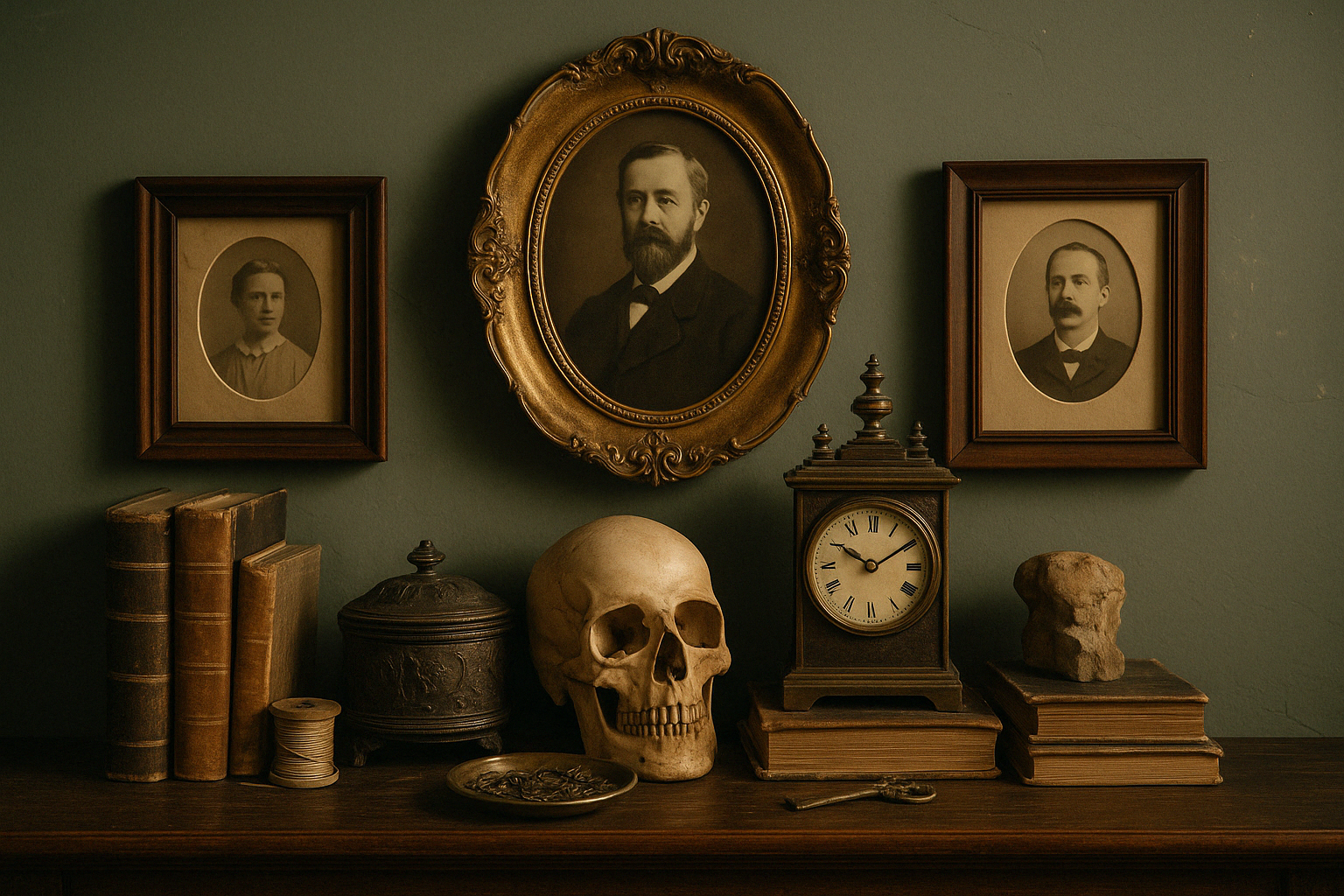
There’s a subtle but fundamental difference between collecting to possess and collecting to safeguard. The true collector isn’t a mere accumulator; they’re a guardian of time, an archivist of emotion, a silent curator of stories that would otherwise risk vanishing. Behind every object they save lies the awareness that what’s held in their hands today has passed through countless hands, inhabited different spaces, and traversed epochs, wars, and transformations. And that only a conscious choice can ensure its future.
Some collectors specialize in rare and precious items, but there are others, perhaps even more touching, who dedicate themselves to humble objects: old sewing boxes, theater tickets, pharmacy bottles, vintage buttons, bottle caps, broken dolls. Not because they have market value, but because they tell something intimate, everyday, and profoundly human. These collectors often don’t have an exhibition room or a catalog; they keep their collections in orderly drawers, in old wardrobes, in boxes with handwritten labels. Yet, for them, each object is a fragment of memory.
An extraordinary example is Enrico, a retired teacher who spent forty years collecting photographs of strangers found in Italian flea markets. Nameless faces, families smiling in front of houses now demolished, children in black and white on deserted beaches. Today, his collection has been digitized by an anthropological research center, becoming one of the most complete private archives of popular 20th-century images. He didn’t do it for money, but to save the identity of those who no longer had a voice.
Or there’s Marta, a restorer by training, a collector of antique fans by passion. Her collection began with a gift from her grandmother and has developed over time with almost philological care. Each fan is analyzed, restored, mounted on handmade supports, with a card that records its dating, technique, and provenance. Some have been exhibited in a temporary exhibition dedicated to 19th-century women’s fashion. Marta considers them “instruments of language, fragments of intimacy.” And indeed, in every carved rib, in every hand-painted paper, one senses the breath of lived history.
But safeguarding isn’t just physical preservation. It’s also transmission, storytelling, sharing. Some collectors choose to keep blogs, social media profiles, or small video channels to show their collections to the public. Not to exhibit them, but to tell stories. Because every object speaks, if you know how to listen. An old iron, a tin box, a pocket watch can tell much more than a history lesson, if placed in the right context, if accompanied by a gaze that captures its soul.
In a world where everything seems to be consumed quickly, collecting is a counter-current gesture. It’s saying: “this object deserves to be saved, to be understood, to be respected.” It’s taking responsibility for protecting it, for giving it meaning. The collector-guardian doesn’t just buy with their eyes, but also with their mind and heart. They know that each piece has a fragility and a dignity. And they know that, in safeguarding it, they are writing an invisible chapter of history.
There’s a silent beauty in the collector’s gestures: in dusting off a frame, in cataloging a print, in finding the perfect spot to display an object so that the light enhances it. These are slow, ancient, almost ritualistic gestures. Gestures that resist time. And that, in the end, tell us a lot about ourselves too: about our desire not to forget, to attribute value to what has been, to build meaning from minimal traces.
Being guardians of time doesn’t mean possessing, but honoring. And this is the deepest heart of collecting: transforming the object into living memory.