
For centuries, distinguishing an authentic painting from a copy relied primarily on the eye and experience of the expert: art historians, antique dealers, and restorers. Visual sensitivity, knowledge of style, and intuition developed over time were the main compasses in navigating the often intricate world of artistic attribution. But today, alongside this expertise, a valuable new ally exists: the science of art, a collection of tools, techniques, and methodologies that allows us to literally penetrate beneath the surface of a work and read it as never before.
Authentication through scientific means is not entirely new – the first experiments date back to the 19th century – but in recent decades it has made remarkable qualitative leaps. Modern technologies not only identify materials and techniques used by the artist but also reconstruct the execution phases of a painting, identify any alterations, hidden restorations, and forgeries.
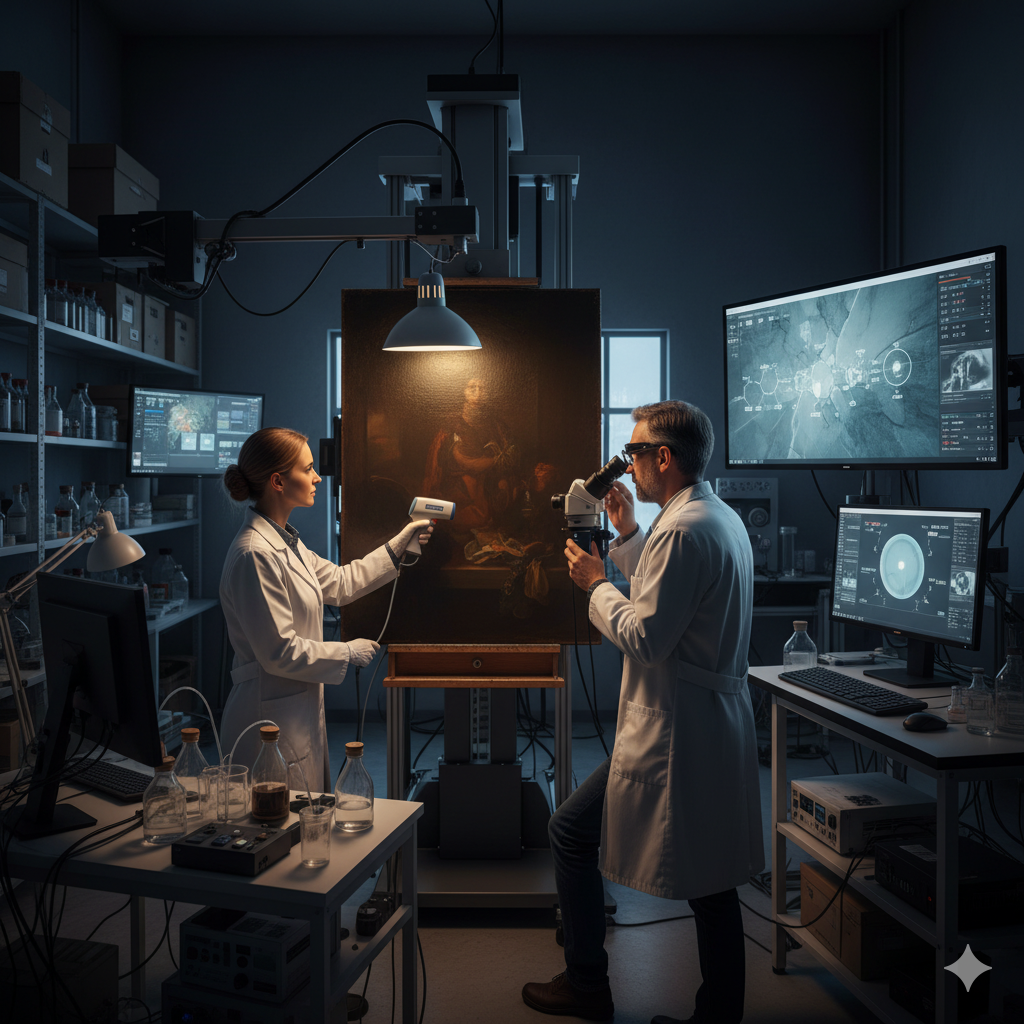
One of the most widely used tools is infrared reflectography, which allows us to see beneath the painted surface, revealing the original preparatory drawing, if present. This detail is crucial: many ancient masters traced preliminary sketches on the canvas or panel, and comparing this drawing with the final work can reveal much about the artist’s hand. A work lacking an underdrawing, or with a visibly uncertain drawing, could indicate a copy.
Ultraviolet-induced fluorescence is also a key tool. By using UV light, it is possible to identify areas where the paint has been retouched or added later, often during restorations. Old and modern varnishes react differently to ultraviolet light, showing chromatic contrasts that the human eye would not perceive in natural light. This type of analysis is particularly useful for understanding how much of a work is original and how much has been reworked.
X-rays allow us to go even deeper, literally. A radiographic analysis allows us to observe the internal structure of the support, the distribution of pigment, the presence of pentimenti (changes during execution), but also hidden details: covered signatures, other paintings reused as a base, modified frames. Sometimes, an X-ray reveals a second painting beneath the visible one, or a completely different composition, revealing reuse practices that were very common in the past.
Spectroscopy and chromatography are instead chemical analysis tools that identify the composition of pigments. This analysis can be decisive: if a painting declared to be from the 17th century contains synthetic colors invented in the 19th century, it is evident that the work is a copy or a forgery. Conversely, the identification of pigments compatible with a certain era strengthens the possibility of authenticity.
Another rapidly expanding field is the analysis of the pictorial binder: oil, egg, animal glue. Each era and pictorial school favored certain materials, and their identification helps place the work in the right context. Some specialized laboratories can now extract micro-samples invisible to the naked eye and analyze their composition with very high precision, without damaging the work.
Non-invasive analyses are also important, now much more accessible and refined than in the past. The use of multispectral scanners, lasers, and advanced photogrammetry allows us to create digital models of the work, map the state of conservation, and document each phase of a restoration with very high definition. These tools do not replace historical and stylistic analysis, but complement it, offering a body of objective data to start from for each evaluation.
Of course, no technology alone can “certify” the authenticity of a work. The final judgment is always the result of an integrated reading: material, historical, and stylistic. But the science of art today provides essential tools to proceed methodically, to avoid scams, to answer complex doubts, and to restore dignity to forgotten or wrongly attributed works.
For the collector, understanding the existence and functioning of these tools means becoming more aware. It is not necessary to become technical experts, but it is useful to know what to ask, who to turn to, when an analysis is really necessary. And above all, it is essential to understand that technology is not an obstacle to beauty: on the contrary, it can be the most effective means to make it emerge with clarity, without ambiguity.
Today, the world of antique paintings can no longer do without science. Because every painting, before being hung on a wall, deserves to be listened to with all the tools at our disposal. And among these, the most silent and invisible ones are often also the most revealing.