

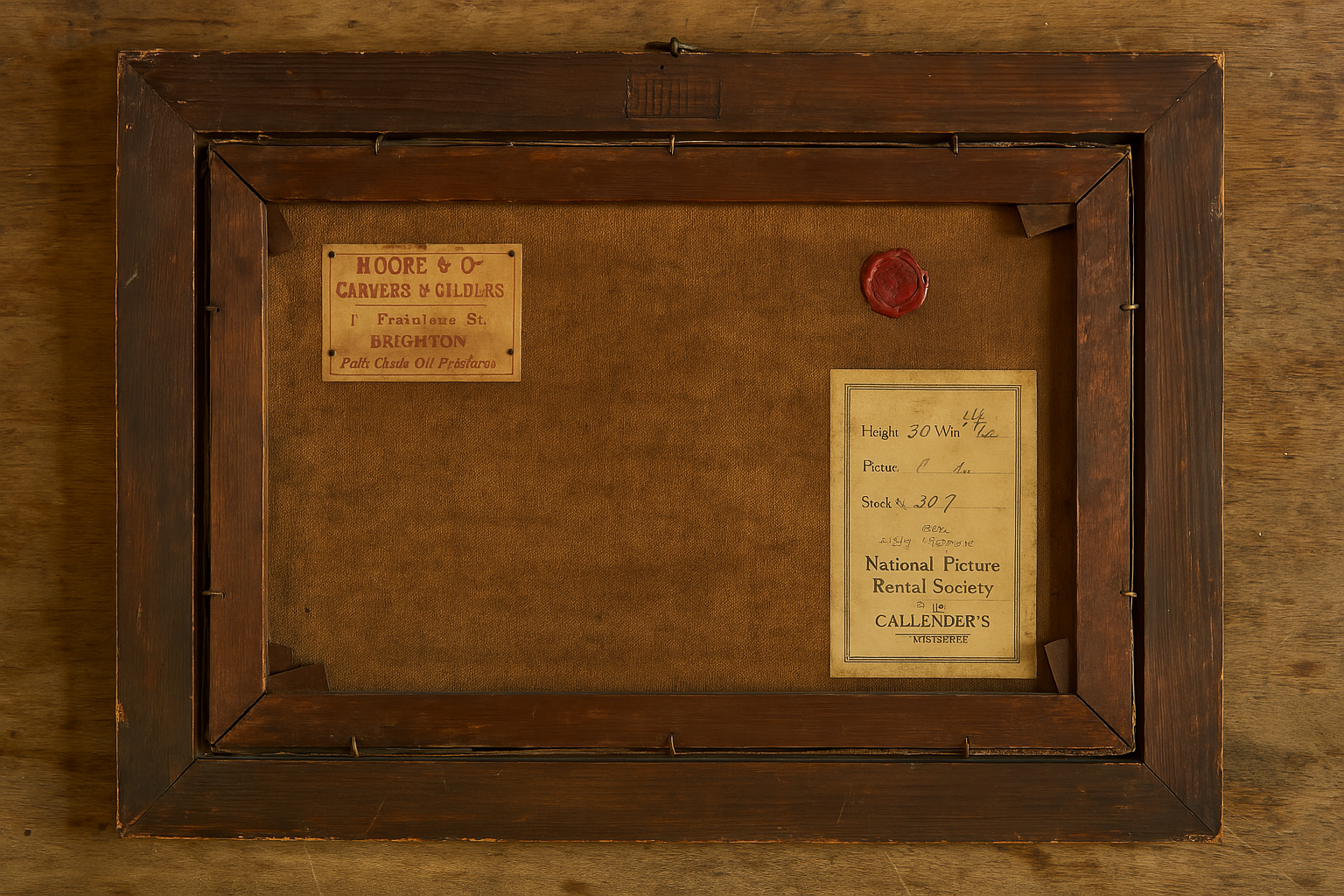
When we stand before an antique painting, it’s natural to focus on the visible surface, the image that captures our attention. We observe the brushstrokes, the composition, the color, the subject. But those with a trained eye know that one of the richest sources of information lies not on the front of the painting, but on the back. It is there that the most precious secrets are often hidden: faded labels, inventory numbers, customs stamps, forgotten signatures, old mounting systems, pieces of canvas added or removed. The back of a painting is, in effect, its travel diary.
In past eras, the cataloging of artworks did not follow standardized criteria like those of today. Museums, collectors, and galleries affixed acronyms, paper or ink labels to register and track their assets. These indications, even if often deteriorated, can now provide fundamental clues about the artwork’s provenance. A small label carefully glued to the frame can indicate the name of a historical exhibition, an auction number, a reference to a catalog, the name of a private collector. A simple stamp can connect the painting to an important gallery or an archive that is now searchable.
In some cases, handwritten notes on the back are even more significant: dedications, artist’s notes, dates, or technical annotations. Especially in the 19th and early 20th centuries, it was customary to write directly on the frame or panel details about the place of execution, the destination of the work, the subject depicted. This information, if authentic, is invaluable: it allows not only to attribute an artwork with greater certainty, but also to place it in the broader context of the artist’s production or the circulation of art in a particular era.
Often, the original signature is also visible on the back, different from the one on the front. Some artists, in fact, signed only on the frame, or left their initials in inconspicuous places. Sometimes, instead, a signature added on the front turns out to be false, while the more discreet one on the back is compatible with documents and autograph styles. Carefully analyzing these inscriptions is a fundamental step in any authenticity verification.
Another crucial element is the type of support. The type of canvas, the quality of the wood in the case of panels, the presence of old gluings or relining, all tell the material history of the artwork. An antique relining, for example, testifies to a conservative restoration, while a modern frame that is poorly inserted may suggest an invasive intervention or an attempt to conceal something. The canvases of the 18th century have a very different grain from those of the 20th century; the nails, if present, tell of different eras: hand-forged, industrial, spiral. Even the simple observation of the frame, if contemporary, can provide fundamental information.
Then there are the customs seals, the shipping labels, the markings of public or private collections that have been disposed of. In some cases, a painting has literally traveled the world before arriving on an easel or in a gallery: it has been shipped to America for an exhibition, it has been sold at auction in London, it has returned to Italy after an inheritance. Reconstructing this journey is a delicate but fascinating operation: each stage confirms, strengthens, legitimizes the artwork.
It must be said that not all the signs on the back are authentic or original. Forgers also act here. They add labels, simulate signatures, apply invented stamps. For this reason, each element must be examined in its context. A writing in modern script on a canvas declared as being from the 17th century is suspicious. An Empire-style frame mounted on a 20th-century painting raises doubts. Inconsistencies do not automatically condemn the artwork, but must be interpreted, explained, and placed in a logical narrative.
Those who professionally deal with authentication spend a lot of time on these aspects. Even before analyzing the painting, the pigment, the composition, the painting is studied as a physical object: it is disassembled, observed, photographed. The back is an integral part of the process of reading an artwork, and in some cases it can resolve complex issues that the sole frontal observation does not clarify.
For the collector, the back of a painting is a mine of information. Even if you do not have technical skills, just learn to observe carefully, not to overlook anything, to ask questions. Every little detail can be the key to reading a much larger story.
In an art world that is increasingly attentive to traceability and transparency, learning to read the back of a painting is a gesture that goes far beyond curiosity: it is a way to truly enter the heart of the history of that artwork. Because, after all, every painting has two faces. And the one that is not seen immediately is often the most sincere.