

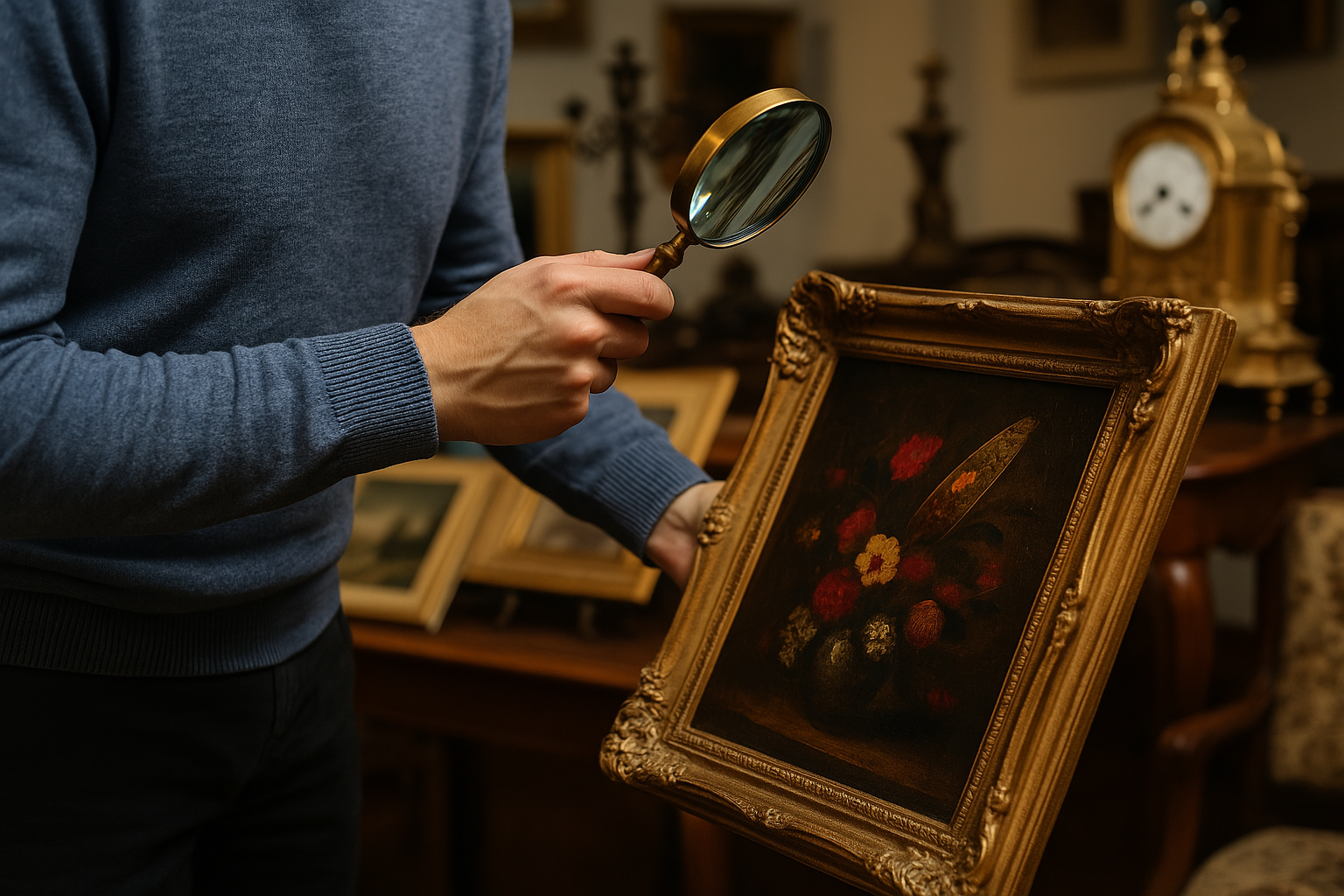
In the world of antiques, the thrill of discovering a rare and valuable item is often tempered by an inevitable question: Is it authentic? Knowing how to distinguish a genuine antique from a copy, a fake, or a reproduction is perhaps the most important – and most challenging – skill for anyone entering this realm. However, you don’t necessarily need to be an expert to start developing a critical eye. Patience, observation, and a willingness to learn from experience are key.
An object’s authenticity reveals itself in many ways, but almost never immediately. The first step is to learn to read the true signs of age. Natural wear and tear is neither uniform nor predictable: a handle worn in the same spot, the edges of a drawer smoothed by use, a wooden surface showing signs of heat, minor scratches, variations in tone due to light exposure – all of these elements are difficult to replicate convincingly. Fakes often try to imitate these effects with artificial techniques, but a keen eye will spot the difference between genuine aging and a process achieved with sandpaper and dark wax.
Then there’s the material. The materials used tell us a great deal about an object. Antique wood, for example, has a density, grain, and color that change over time. Similarly, metal alloys, screws, glues, even glass or varnishes, change composition over the ages. Being able to distinguish a hand-forged nail from an industrial one, a shellac varnish from a synthetic one, can make all the difference between a period piece and a ‘style’ piece.
Stylistic and constructive consistency are also critical. An authentic object reflects the style of the period in which it was made, as well as the construction techniques of the time. A piece of furniture declared to be from the 18th century but assembled with Phillips-head screws or industrial joints cannot be authentic. Likewise, a Baroque mirror with a too-uniform gilding, lacking natural cracking or oxidized areas, deserves suspicion. Fakes are often too perfect: the patina is uniform, the surfaces are overly manicured, and they lack the small flaws that only use and time can create.
The eye also plays a part, but with caution. Sometimes, in fact, the visual aspect is the most deceptive. Some fakes are aesthetically very convincing, and that is precisely why they should be observed slowly and methodically. It’s even better if you have the opportunity to touch, open drawers, look behind back panels, or under bases. Truths often lurk there: signs of manual carpentry, old woodworm, original labels, or, conversely, mismatched materials, inconsistent finishes, or suspicious color layering.
Documentation deserves its own section. Objects of greater value, especially in the international market, are often accompanied by certificates, technical specifications, publications, or excerpts from auction catalogs. However, attention is needed here as well: not all certificates are created equal, and in a world where everything can be photocopied or counterfeited, it’s good to know who drafted that document and with what authority.
In this phase, trusting common sense is essential. If the price is too low compared to the estimated value, if the seller insists too much on the rarity, if the object is sold without the possibility of verification or with resistance to answering specific questions, then it is time to stop. Intuition, when trained by experience, becomes a valuable ally. And it’s never a weakness to ask questions, seek confirmations, and take the time to reflect before buying.
Finally, for those who really want to delve deeper, it is advisable to start their own visual documentation: collecting photos, notes, and observations. Visit exhibitions, fairs, museums, and browse catalogs. Every authentic object observed in person adds a piece to one’s sensitivity. Over time, the fake becomes recognizable even from a wrong line, from a detail out of place.
Recognizing authenticity is not just a matter of technical expertise: it’s a journey, a continuous exercise in attention and respect. Because ultimately, every authentic antique object is more than just a piece of furniture: it’s a true story. And true stories, as we know, are always recognized – if we really listen to them.