

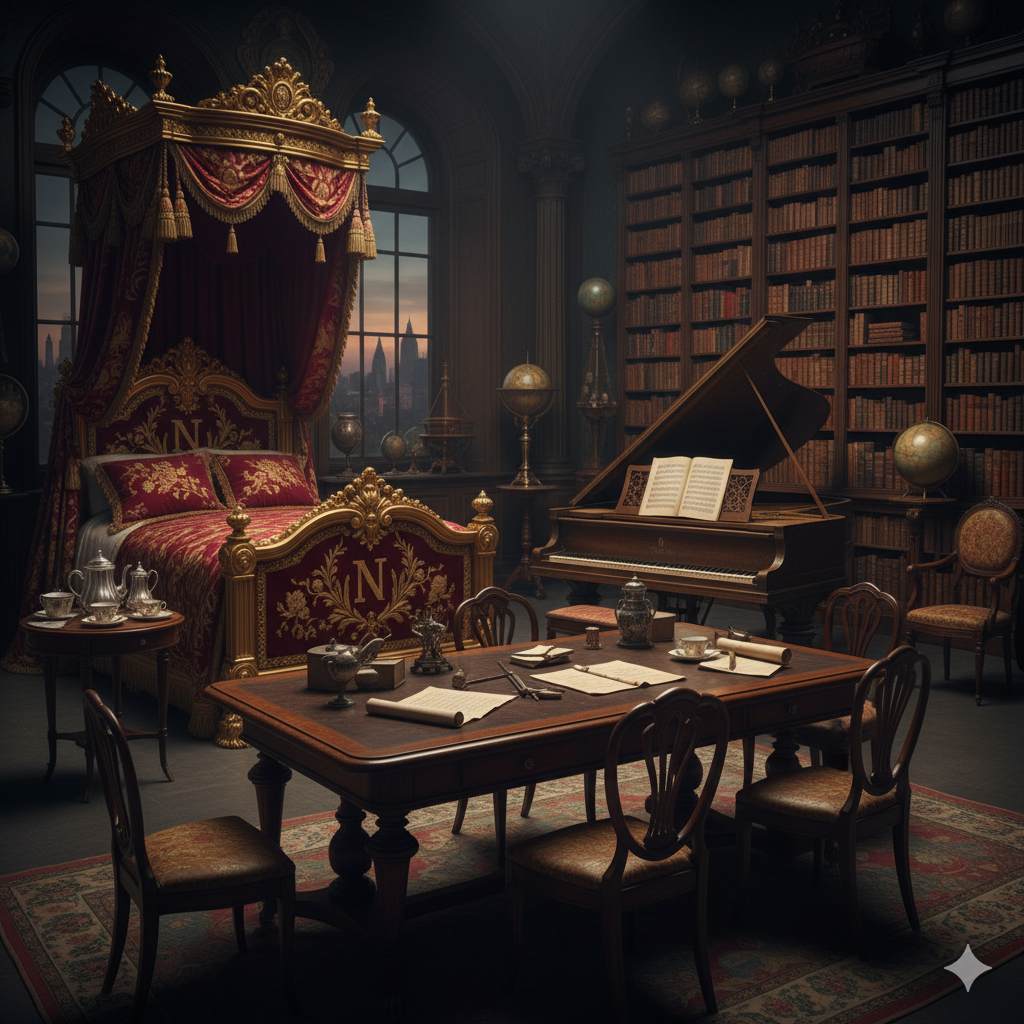
Antiques are not just masterpieces of craftsmanship; they often carry incredible stories that enhance their value. Many pieces have weathered wars, revolutions, and pivotal historical moments, becoming silent witnesses to bygone eras. In this second installment, we explore more famous antiques and the fascinating tales surrounding them.
- The Table of the United States Declaration of IndependenceOne of history’s most celebrated tables is the one on which the United States Declaration of Independence was signed on July 4, 1776. This historical furniture piece was located inside the Pennsylvania State House (now Independence Hall) in Philadelphia.Fun Fact: It is said that the signatures were affixed in great secrecy, as the signatories risked being accused of treason against the British Crown.Where it is Today: Preserved at Independence Hall, it is still on public display as a symbol of American freedom.
- Napoleone Bonaparte’s Bed: An Emperor’s RestNapoleon Bonaparte spent much of his life on military campaigns, but some of his private chambers were furnished with finely decorated beds, often transported with him during his expeditions.Fun Fact: One of his most famous beds, preserved at Malmaison, features an elegant mahogany frame with gilded details.Where it is Today: Some of Napoleon’s beds are kept in French museums, including the Musée de l’Armée in Paris.
- Queen Victoria’s Tea SetQueen Victoria, known for her refined taste, owned an exclusive tea set in finely decorated porcelain, used to receive distinguished guests.Fun Fact: This set was used in the salons of Buckingham Palace to entertain dignitaries and members of the royal family.Where it is Today: Some original pieces are preserved in the British royal collections and at the Victoria and Albert Museum.
- Ludwig van Beethoven’s PianoOne of the most iconic instruments in classical music is the piano used by Ludwig van Beethoven to compose some of his most celebrated works.Fun Fact: Beethoven, who became completely deaf in the later years of his life, used his sense of touch to perceive the vibrations of the instrument.Where it is Today: His last piano is exhibited at the Beethoven-Haus in Bonn, Germany.
- Thomas Jefferson’s LibraryThe third President of the United States, Thomas Jefferson, was an avid reader and possessed one of the largest personal libraries of the time.Fun Fact: After the Library of Congress was destroyed by a fire in 1814, Jefferson donated his entire collection of books to reconstitute it.Where it is Today: Much of his original library is still preserved in the Library of Congress in Washington, D.C.
Conclusion
Every antique has a story to tell, whether it’s a piece of furniture that belonged to a monarch, an object used in historical events, or a piece that accompanied great artists and musicians. Discovering these stories not only adds value to the objects themselves but allows us to connect with the past in a unique and fascinating way. The next time you observe an antique, pause to ask yourself: what secrets might it hold?