

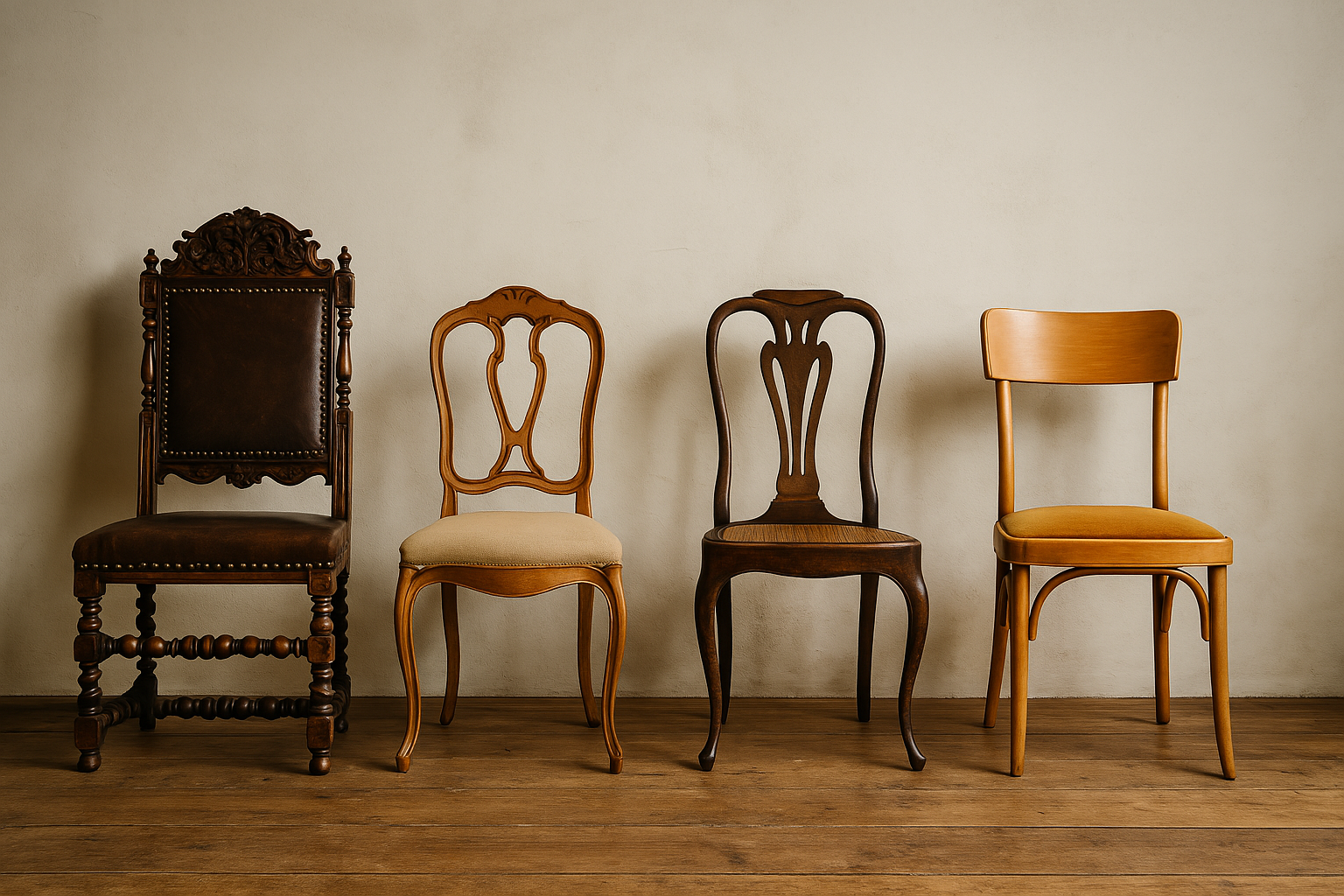
Restoring an antique chair is an act of care and respect for the object’s history, as well as an opportunity to rediscover the art of materials. Behind every seat lies a world of precise craftsmanship, decorative traditions, and functional techniques that have spanned centuries. When the time comes to restore dignity to an old chair, the question is inevitable: what materials should be used to make it sturdy, beautiful, and consistent with its era?
The first choice concerns the wood, the true structural heart of most antique seating. Common chairs from the 19th and 20th centuries were often made of beech, walnut, oak, or chestnut, depending on the geographical area and the client’s social status. Beech, for example, was widely used because it is flexible and strong, ideal for curved and lightweight seats. Oak, more massive and veined, is often found in rustic and work chairs. Walnut is typical of bourgeois or ecclesiastical furniture, while cherry or maple are found in more decorative and inlaid models.
When replacing missing or damaged parts, it is important to choose compatible woods, not only in terms of color and grain but also in terms of density and mechanical behavior. Wood that is too hard could crack the original joints, while wood that is too soft may not last over time. That’s why, during restoration, the experienced craftsman works not only with their hands but also with their eyes and ears, seeking material harmony.
Another fundamental element is the seat, which can be straw, padded, or solid wood. In the case of straw seats, there are many possibilities: Vienna straw (the thin and elegant honeycomb weave), marsh straw (thicker, suitable for rustic seats), cane, and natural raffia. Each has its specific technique and requires dedicated tools. Real straw is always preferable to synthetic versions: it is more elastic, ages better, and, above all, respects the historical coherence of the chair.
Upholstery, on the other hand, tells its own story. Until the mid-20th century, hand-tied steel springs, vegetable or animal hair, jute, and natural fabrics were used. Only later did foam padding become widespread, often glued or sewn onto less valuable structures. In a respectful restoration, the aim is to restore the original materials or replace them with quality equivalents: coconut fiber, plant-based felt, jute canvas, and hand-tied springs. Each layer has a function: elasticity, shape, insulation, and aesthetics.
Then there’s the issue of the covering. The choice of fabric is one of the most delicate because it influences not only the final appearance but also the historical perception of the piece. Brocades, velvets, damasks, and Flemish canvases were used for 19th-century seats. For Art Nouveau and Art Deco pieces, printed cottons, decorated linens, and stylized geometric or floral patterns were common. Today, the market offers re-editions of many period fabrics, but it is also possible to recover original remnants or rely on artisanal prints on linen and hemp. The important thing is to avoid fabrics that are too synthetic, too rigid, or with anachronistic patterns.
Attaching the fabric is a technical but also an aesthetic phase. The use of tacks, decorative nails, or trimmings can enhance the seat, but it must be consistent with the style of the chair. A Louis XV armchair will need elegant details, while an Art Nouveau chair will handle visible metal elements and bolder shapes well.
Finally, there are the finishing treatments, such as natural waxes, protective oils, and transparent water-based varnishes. Matte and soft-to-the-touch finishes are preferred for rustic furniture; for bourgeois furniture, a French polish can be chosen, which gives depth and brilliance. Here too, respect for the original material is fundamental: the patina of time should not be erased but only enhanced.
Restoring an antique chair means entering into a dialogue with the craftsman who built it, with the house that hosted it, and with the hands that used it. The choice of materials is never just technical: it is a cultural, emotional, and aesthetic choice. And it is also, today more than ever, an ethical choice: using natural, durable materials that are compatible with the history of the piece means contributing to a new idea of sustainability, based on care, maintenance, and lasting beauty.