

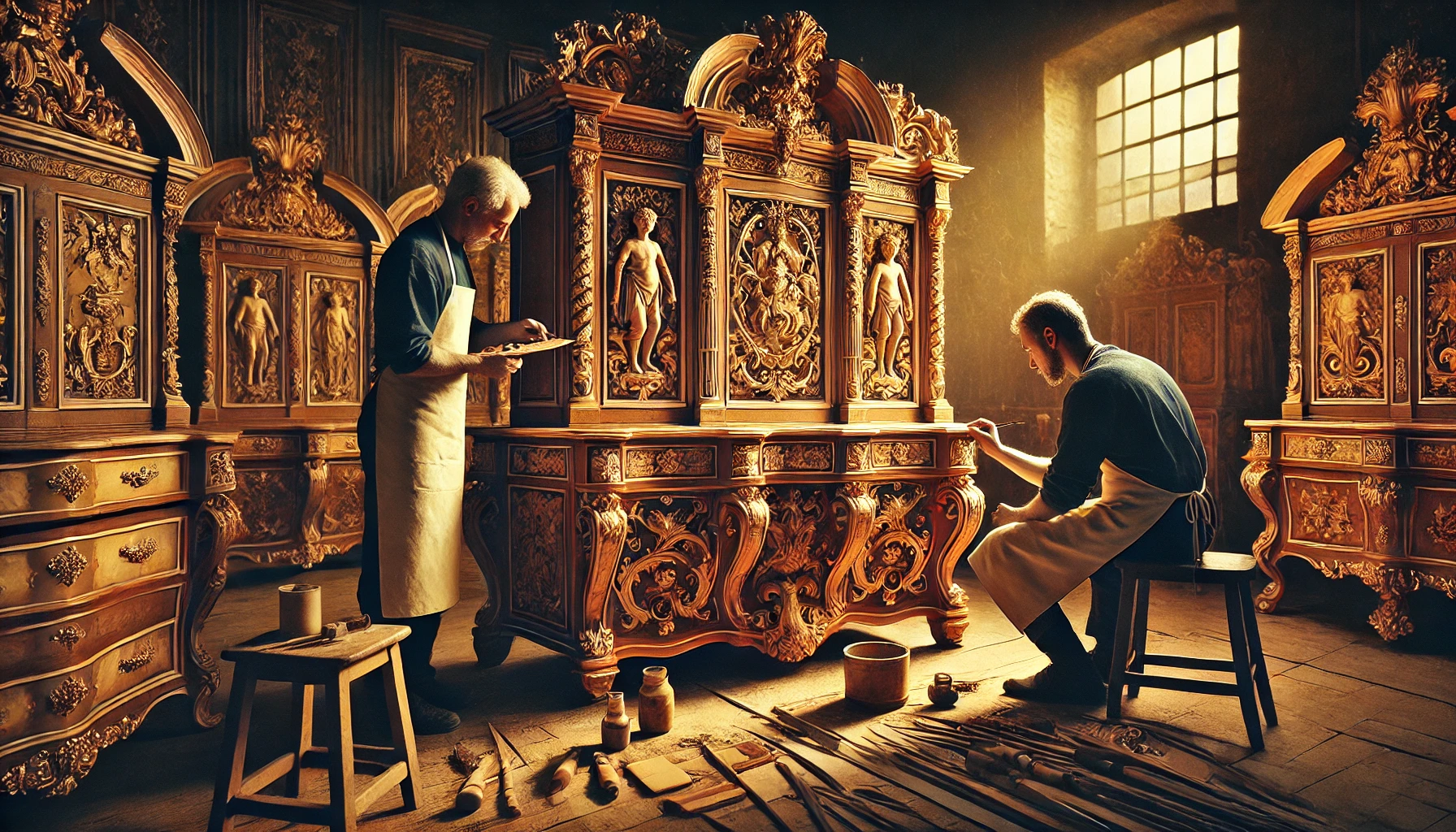
Louis XV and Louis XVI style furniture pieces are masterpieces of craftsmanship, embodying the taste and refinement of 18th-century French decor. Beyond their design and elegant forms, their uniqueness lies in the mastery with which they were created. The crafting techniques employed, from inlays to gilding, reflect the skill of the artisans of the era and continue to influence the production of luxury furniture. In this article, we explore the primary techniques used in the creation of these extraordinary furnishings.
1. The Art of Inlay and Marquetry
Inlay and marquetry were among the most popular decorative techniques in Louis XV and Louis XVI furniture. These methods involved embedding precious woods or other materials to create ornamental motifs on the surface of the furniture.
- In Louis XV style, inlays were characterized by sinuous and asymmetrical designs, often inspired by nature with flowers, leaves, and shells.
- In Louis XVI style, marquetry took on a more geometric and symmetrical character, with classic motifs such as garlands, medallions, and rosettes.
Woods used included ebony, rosewood, mahogany, and bois de rose, while mother-of-pearl, ivory, and precious metals were used to further embellish the surfaces.
2. Gilding: Luxury and Brilliance
Gilding was one of the most elaborate techniques for giving furniture a regal and opulent appearance. This process involved applying thin gold leaves to the wooden surface using water gilding or oil gilding techniques.
- In Louis XV style, gilding was particularly rich and abundant, highlighting the carvings with a striking, theatrical effect.
- In Louis XVI style, while remaining an important decorative element, gilding was used with greater restraint, accentuating details without overwhelming the surfaces.
The process required several steps, including preparation with Armenian bole, application of gold leaf, and polishing with agate stones to impart brilliance.
3. Carving and Sculptural Decorations
Carving was a fundamental technique for creating ornamental furniture, handcrafted by expert cabinetmakers.
- In the Louis XV style, carvings featured rocaille motifs, inspired by natural and irregular forms, with volutes and floral details.
- In the Louis XVI style, carving became more rigorous and symmetrical, with decorations that echoed classical architectural motifs, such as fluted columns and ornamental friezes.
The carved parts were often accentuated with gilding or patination to enhance their relief and depth.
4. Fine Varnishes and Lacquers
The finishing of surfaces was as important as the structure of the furniture. Techniques such as lacquering and French polishing made it possible to achieve refined aesthetic effects and protect the wood over time.
- Louis XV lacquers were distinguished by vibrant colors and the use of exotic decorations inspired by China and Japan, such as Coromandel lacquer.
- Louis XVI finishes were more understated and refined, often with transparent varnishes that highlighted the natural beauty of the wood.
French polishing with shellac conferred a brilliant and silky effect, protecting the surface from external agents.
5. Joinery and Structural Techniques
In addition to decorations, the solidity and durability of furniture depended on the quality of the joinery and assembly systems used.
- In the Louis XV style, the joints were hidden, with curved structures that required a high degree of craftsmanship.
- In the Louis XVI style, the connections were more rational and solid, with mortise and tenon joints that guaranteed greater stability.
The furniture was often made with frames in oak or walnut, to ensure robustness without compromising visual lightness.
Conclusion
The crafting techniques used in Louis XV and Louis XVI furniture represent the pinnacle of French cabinetmaking in the 18th century. Inlay, gilding, carving, and varnishing are just some of the practices that give these furniture pieces a timeless appeal. Even today, artisans and designers continue to draw inspiration from these methods, keeping alive a tradition that combines beauty, elegance, and mastery.