
Brilliant, elegant, timeless. Silver is one of those materials that has traversed the centuries, maintaining its charm intact. A symbol of prestige and refinement, antique silverware has adorned the tables of noble families, embellished altars, thrones, and palaces, and for a long time, has been synonymous with wealth and social distinction. Today, for collectors, enthusiasts, and antique dealers, knowing how to recognize an vintage piece and correctly assess its value is not just a matter of taste, but a true art form, requiring knowledge, sensitivity, and a trained eye for detail.
The Language of Silver: How to Read an Antique Object
The first step in recognizing an antique silver object is knowing how to decipher its markings. Every silver object, starting from the 18th century, bears a series of hallmarks – small marks impressed into the surface – that reveal fundamental information: the origin, the purity of the metal, the year of production, and in some cases, even the identity of the silversmith.
In Italy, as in many other European countries, the system of hallmarks has been regulated over time, but it is primarily the 19th and early 20th-century hallmarks that attract the interest of collectors. Often, by carefully observing these small marks, one can reconstruct the history of an object, the city in which it was made, the historical context, and the style of the era.
Alongside official hallmarks, it is not uncommon to find private or workshop hallmarks, which are more difficult to interpret but extremely valuable to those who can read them. A small lion’s head, a number in an oval, a six-pointed star: each symbol is a fragment of identity, a stamp left by the past.
From Style to Function: Context as a Key to Interpretation
However, it is not enough to read the hallmarks; to evaluate a piece of silverware, it is essential to recognize its style and place it within a specific period. Silver, in fact, faithfully reflects the aesthetic tastes of its time. A Rococo centerpiece is recognized by its flowing volumes, dense decorations, and naturalistic motifs. A Neoclassical candlestick, on the other hand, will be linear, sober, and inspired by the simplicity of Greco-Roman art.
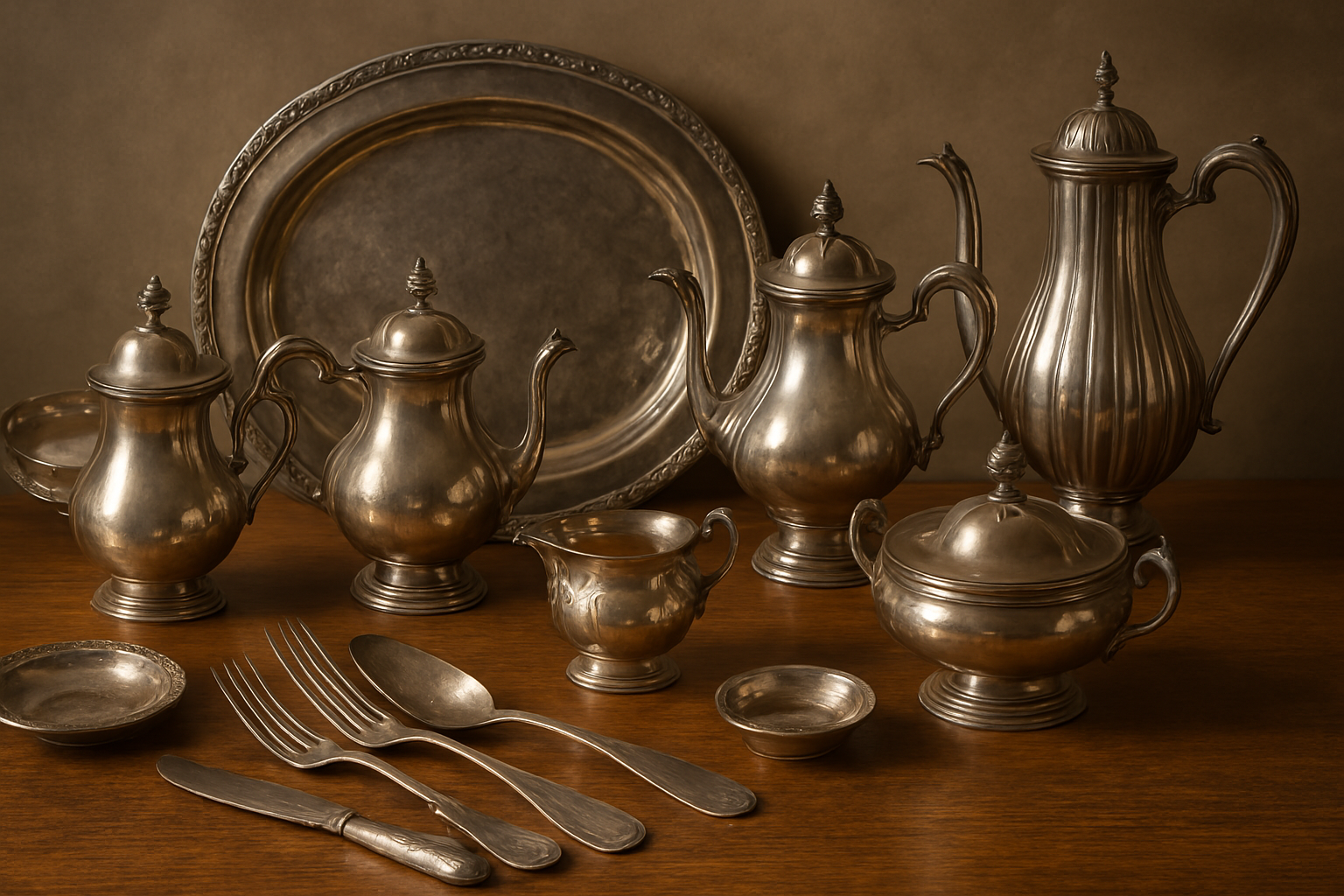
Beyond the style, the function of the object is also crucial. Many silver objects were made for specific uses that have now been lost: chocolate pots, hot chocolate jugs, vinaigrette decanters, muffin holders, and vanity sets. Some of these objects, even if small or seemingly insignificant, can reach very high prices precisely because of their rarity or the specificity of their function.
And then there are the manufacturers, the signatures, the great names of the goldsmithing and silversmithing tradition. A piece produced by the Buccellati Manufactory, by a London firm like Garrard, or by a Parisian workshop from the era of Napoleon III will have a very different value compared to a more common object, even if visually similar.
The Value of Silver: Beyond the Weight
One of the most frequent mistakes in evaluating an antique silver object is to limit oneself to its intrinsic value, that is, the weight of the metal. Certainly, silver has a market value that fluctuates according to the daily price, but in the case of antique silverware, this parameter is the least relevant.
An antique silver object is valued for its rarity, its state of conservation, its historical provenance, and above all for the quality of its execution. An 18th-century hand-chased soup tureen, with relief decorations and zoomorphic handles, can be worth hundreds of times its weight value.
The state of conservation also influences the price. Silver is a delicate material, sensitive to humidity and air. A well-preserved object, with few signs of oxidation and with any declared and well-executed restorations, will maintain a stable or even increasing value over time.
The context of sale should also not be overlooked: a silver object sold in an important auction, with a documented history, may reach much higher prices than a similar one found in a flea market or in a domestic inheritance.
Solid Silver or Plated? Distinguishing Without Errors
Another fundamental skill for those approaching antique silverware is knowing how to distinguish between solid silver and silver plate. To the naked eye, it is not always simple: both materials have a similar patina, but profoundly different in terms of value and durability.
The surest way to verify the nature of silver is to observe the hallmarks. In Italy, solid silver is marked with numbers such as “800”, “925”, “950”, which indicate the purity of the silver compared to other alloys. Plated objects, on the other hand, may bear terms such as “silver plate”, “EPNS” (Electro Plated Nickel Silver), or simply vague symbols without certification.
Silver plate has a thin layer of silver on a base of common metal, and with use, it tends to lose its finish, revealing the underlying surface. Solid silver, on the other hand, is uniform throughout its structure and can be polished and restored, maintaining its value unchanged.
The Soul of the Object: Beyond Aesthetics
But finally, the most fascinating aspect of antique silverware is not only the economic value or the craftsmanship. Every silver object has a soul, a past, a history that can be revealed only with attention and respect.
A sugar bowl can tell the story of the social rituals of the 19th-century bourgeoisie. A tray engraved with faded initials can evoke a forgotten wedding gift. A small perfume holder can encapsulate the intimate habits of an 18th-century lady.
Recognizing, evaluating, and collecting antique silverware means coming into contact with these worlds. It is not just about beautiful or precious objects, but about fragments of past existences that we can now preserve, understand, and pass on.