

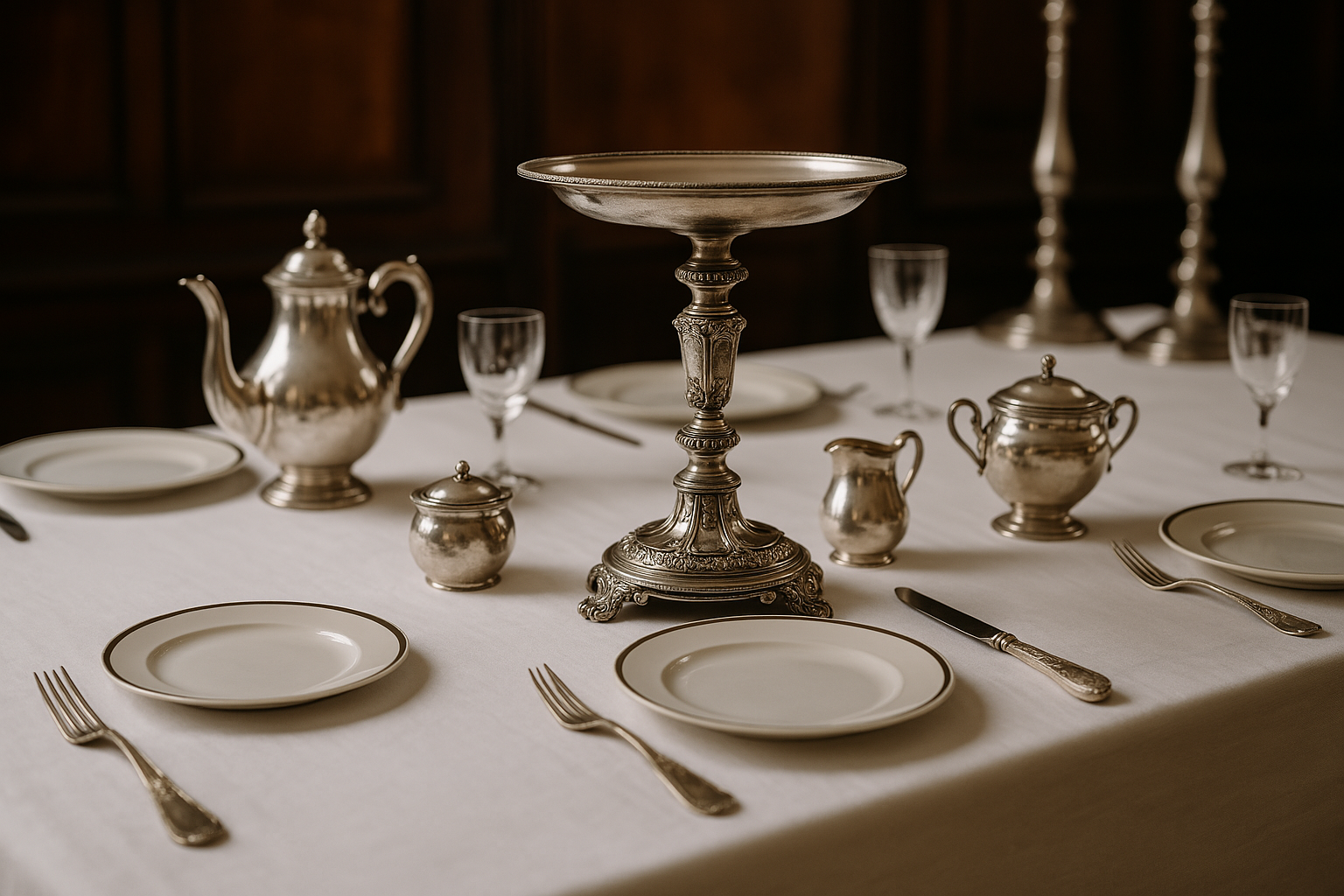
When we see antique silverware, we’re often struck by its beauty, the finesse of its craftsmanship, and the weight of the material. But we rarely stop to imagine how these objects were actually used in the daily lives of those who owned them. Silverware wasn’t made to be locked away in a display case. For centuries, it served a practical function, an integral part of the rituals of dining, personal care, hospitality, and social representation.
To fully appreciate the value of antique silverware, we need to immerse ourselves in its original context: aristocratic homes, bourgeois parlors, and grand ceremonial feasts. There, every spoon, every carafe, every tray had a specific place, a meaning, and a function, often linked to customs now forgotten.
The Art of Dining: Luxury and Ritual
In the noble residences of the 18th and 19th centuries, the dining table was more than just a place to eat. It was a social stage, a symbolic space where power, taste, and refinement were displayed. Silverware played a central role in this performance.
An important dinner could require dozens of silver pieces: from the soup tureen to the consommé spoon, from the individual salt cellar to the sorbet spoon. Each dish, each drink, each moment of the meal had its dedicated object, designed to enhance not only the food but the entire dining experience.
Silver centerpieces, often monumental, were not only decorative but also served to hold candelabras, fresh flowers, sculpted fruits, or seasonal arrangements. Some were veritable allegorical triumphs, with mythological figures, cherubs, and animals, crafted by goldsmiths of extraordinary skill.
Cutlery also tells us a lot about the evolution of taste. Complete sets could exceed 100 pieces, including specific utensils for each food: fish forks, cheese knives, asparagus tongs, and pierced spoons for absinthe. Many of these utensils seem superfluous today, but in the past, they represented an almost obsessive attention to etiquette and the refinement of service.
Parlor Objects and the Habits of Conversation
It wasn’t just the dining table. The bourgeois parlor was also dotted with silver objects, each with a specific function. The tea ritual, for example, involved an entire set consisting of a teapot, milk jug, sugar bowl, teaspoons, a tray, and sometimes even a cup and saucer in chiseled or hand-hammered silver.
Equally common was the use of the so-called “smoking set,” with cigar holders, match holders, and ashtrays in silver, often decorated with masculine or sporting motifs. In many cases, these sets were personalized with family crests or monograms, making them deeply meaningful objects.
In boudoirs and private rooms, one could find vanity mirrors, powder boxes, perfume bottles, and combs with silver handles. Seemingly ephemeral objects, but ones that clearly defined the lifestyle and self-awareness of the affluent classes.
Silver as a Gift and as a Symbol
Antique silverware also reflects a culture of gift-giving that has now disappeared. Silver objects were given as gifts for weddings, baptisms, anniversaries, and public appointments. Each gift had a symbolic value: a goblet to wish prosperity, a bowl to evoke abundance, a silver frame to celebrate the family.
Many of these objects still bear engraved inscriptions, dates, and the names of the recipients: touching testimonies of personal relationships and social rituals. Even in religious ceremonies, silver has played a central role, from the monstrance to the pyx, from the incense boat to the thurible. In these cases, the metal took on a sacred meaning, becoming a vehicle of purity and divine light.
A Surviving Legacy
Today, antique silverware survives primarily as a collector’s item, but some choose to bring it back to the table, to restore its original function. This is not a simple nostalgia, but a conscious gesture. Using an 18th-century silver spoon, pouring from an Empire-style teapot, setting the table with hand-chiseled cutlery is a way to reconnect with a broader history, with an everyday beauty that has spanned centuries.
Many high-end restaurants, especially in France and England, have rediscovered the charm of serving with vintage silverware. Similarly, young contemporary designers and artisans are inspired by objects of the past to create new forms of conviviality.
In a world that rushes by, silver reminds us of the importance of slow time, of care in gestures, of memory in details. It’s a precious legacy that never stops speaking, if we are willing to listen.