

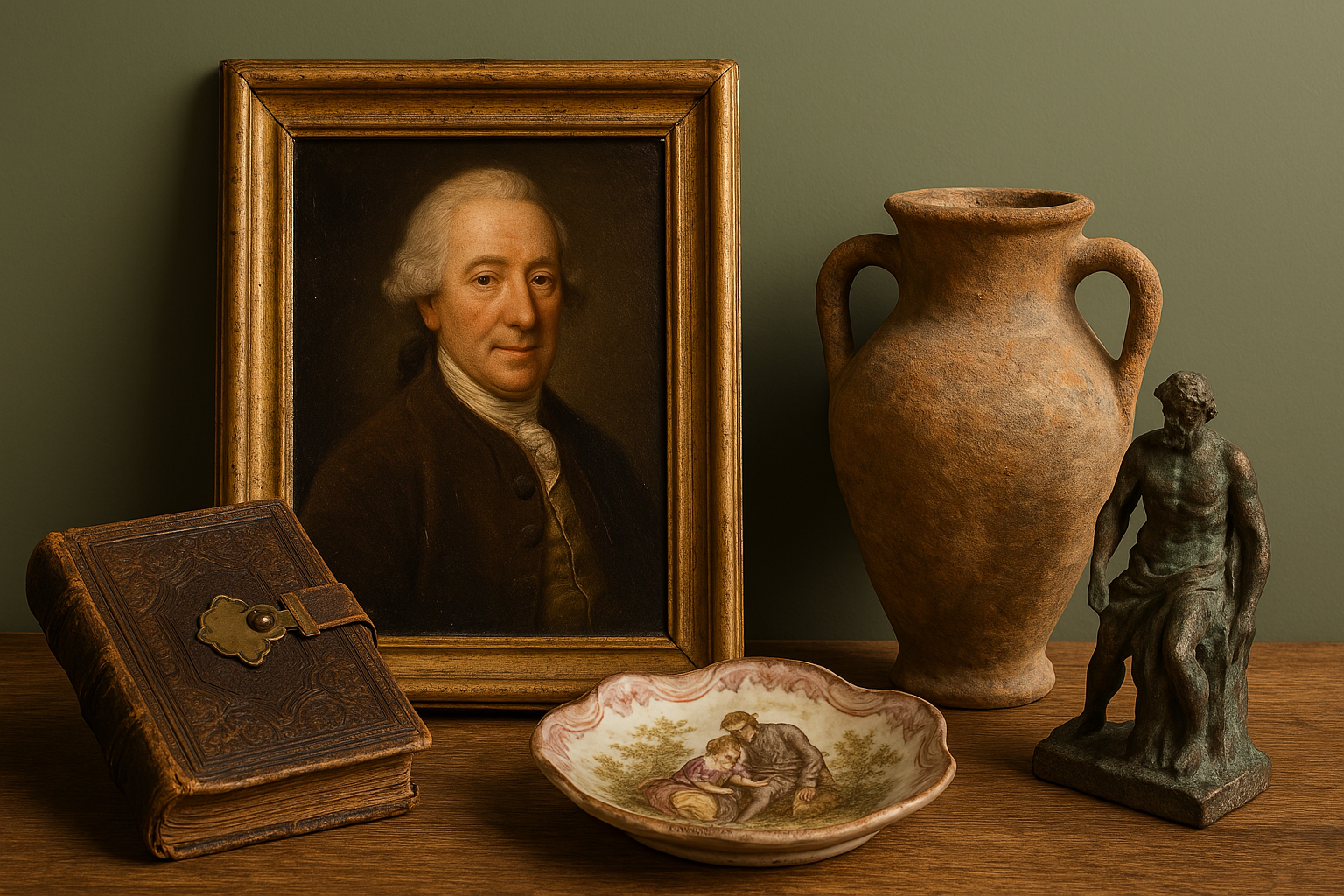
In the world of antiques and material culture, few stories are as captivating as those about objects once considered useless, superfluous, or simply old… that unexpectedly turn out to be cultural assets of inestimable value. It happens more often than one might think: what we discard or sell for pennies today was once an integral part of a bygone daily life, and tomorrow it could be studied, exhibited, and admired by thousands. Time, in these cases, is the greatest restorer.
Consider all the private collections that were broken up or dispersed during the 20th century. In many attics, cellars, or emptied houses, items deemed “old junk” ended up in flea markets, landfills, or charity sales. Yet, among those piles of seemingly useless things, rare historical testimonies, unique pieces, period documents, and uncatalogued handcrafted works were often hidden. Today, many of these have found their way into museums thanks to an intuition, a fortuitous recovery, or an enlightened donation.
A famous example is the collection of 19th-century household utensils found in a small farmhouse in Piedmont, Italy. Pots, pans, dishes, kitchen tools, terracotta bowls, and even wooden potato peelers, left in a storage room for decades. Everything was about to be thrown away, but a local anthropologist was invited to “take a look.” That collection turned out to be an exceptional snapshot of pre-industrial peasant culture, now displayed in a regional ethnographic museum. Each object, devoid of economic value, was an essential piece for understanding an entire era.
Another case concerns the world of fashion. In the 1970s, a retired seamstress donated a trunk full of formal dresses from the 1920s and 30s to a flea market. They were hand-sewn dresses, with beads, silks, laces, and embroidery. No one wanted them until they were noticed by a costume historian. It was discovered that those dresses were prototypes commissioned by a little-known Parisian fashion house closely linked to avant-garde circles of the time. Today, they are part of the archive of a major European textile museum.
Even “non-aesthetic” objects, such as school documents, technical models, and work tools, are often ignored. Yet they are an invaluable source for archaeologists and historians. An old rusty planimeter, for example, can tell the story of the birth of modern urban planning. A simple box of children’s paints, found among the waste of a disused school, may contain pigments no longer commercially available, precious for restorers.
Among the most incredible stories, there are also those of objects passed down through generations in indifference, until they were finally recognized. This is the case of a wooden sculpture kept in a garage for decades, used as a doorstop. Only after a move did someone decide to have it evaluated. It turned out to be a 12th-century Romanesque piece, depicting a very rare saint, with evident traces of original polychromy. Today it is visible in a display case, restored and protected, after a life spent in anonymity.
What all these stories have in common is a simple but often forgotten truth: value is not always visible. It is not only in the signature, in the noble materials, in the fame of an object. It is also – and above all – in its ability to tell something vintage, to restore a piece of lost humanity. Discarded objects, if saved at the right time, become witnesses of what we once were.
This is why the most exciting pieces are often found in ethnographic, technical, children’s, and everyday-life museums. Not famous works, but “normal” objects that survived oblivion only because someone, at some point, decided not to throw them away.
Every time we pass a box of forgotten objects, it’s worth stopping to look. Because sometimes, what is rejection today might tell a story tomorrow that no book could narrate so well.