

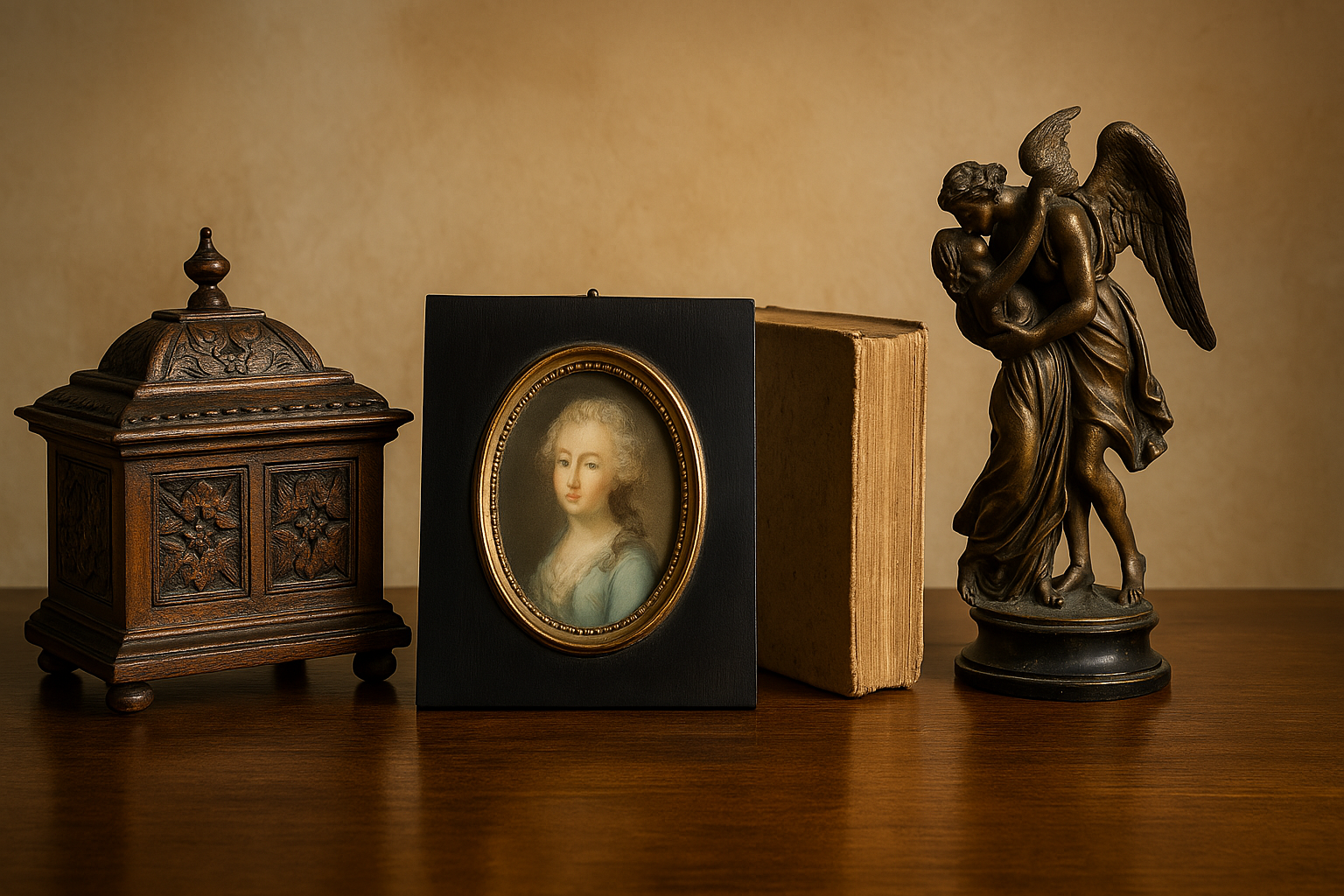
Every antique object harbors a story. But sometimes, what appears as merely a beautiful artifact or a curious trinket reveals itself to be a fragment of an intense existence, an unexpected tale, or even a forgotten historical event. Some of the most surprising discoveries don’t concern economic value, but narrative content: these are the objects with a secret life, those that, after years of silence, speak again thanks to the attentive gaze of those who know how to listen to them.
These stories often begin by chance. At a village market, on a table amidst old dishes and toys, a woman finds a locket. She buys it for a few euros, attracted by its refined craftsmanship. Only later, examining it carefully, does she discover that it is a Victorian gold portrait holder, with the effigy of a British officer engraved inside. Intrigued, she begins a search that leads her to the war archives: the locket belonged to the wife of an officer missing in Crimea in 1854, who never returned home. The object becomes the starting point to reconstruct a broken love story, forgotten for over a century.
Another emblematic case concerns a wooden box purchased by a young collector at a French flea market. Apparently ordinary, it featured inlays and a locked clasp. After carefully forcing it open, a small bundle of handwritten letters was found inside, wrapped in linen cloth. It was private correspondence between two 19th-century intellectuals, bound by a secret and thwarted love. The letters, later published in a volume, shed new light on cultural figures of the time and their unknown private lives.
In other cases, it is the simple use of the object that tells a story. An English porcelain cup found at a thrift store in Ireland showed a minor crack, but tiny marks were noticeable inside the lower rim: these were handmade engravings, datable to the early 1800s, used by servants in noble houses to count the original sets and not confuse them with those for “guests.” A sign of social hierarchy etched into an everyday object.
Other times, it is the dedications that reveal the hidden narrative. An illustrated book found in Prague contained, on the first page, a faded pencil inscription: “For E., so that she never forgets that sunset on the Danube.” Just a few cross-referenced facts were enough to discover that the volume belonged to a young musician and was donated by a composer of the time, known in Central European salons. From an intimate gesture, a biographical reconstruction was born that restored life to two otherwise unknown figures.
What all these stories have in common is the ability of objects to preserve human traces. The cracks, signatures, trademarks, seams, signs of wear are not defects, but testimonies. Objects with a secret life speak, but in a subtle way: you have to know how to question them, open them, compare them, immerse yourself in the context from which they come. This, after all, is the heart of intelligent collecting: not just possessing, but reconstructing, understanding, engaging with the past through matter.
In the antique market, these objects can go unnoticed. They do not attract for their aesthetics or for the signature, but for what they conceal. And sometimes, these are precisely the most exciting objects: not the most expensive, but those that give us back a human fragment, a forgotten voice, a minor story that, precisely because it is forgotten, deserves to be told again.
For this reason, every time we observe an antique object, we should ask ourselves: what secret does it hold? Which hand held it, which journey did it make, which silence did it cross before reaching us?
Because objects, like memories, are not lost. Sometimes they hide. Waiting for someone to know how to read them.