

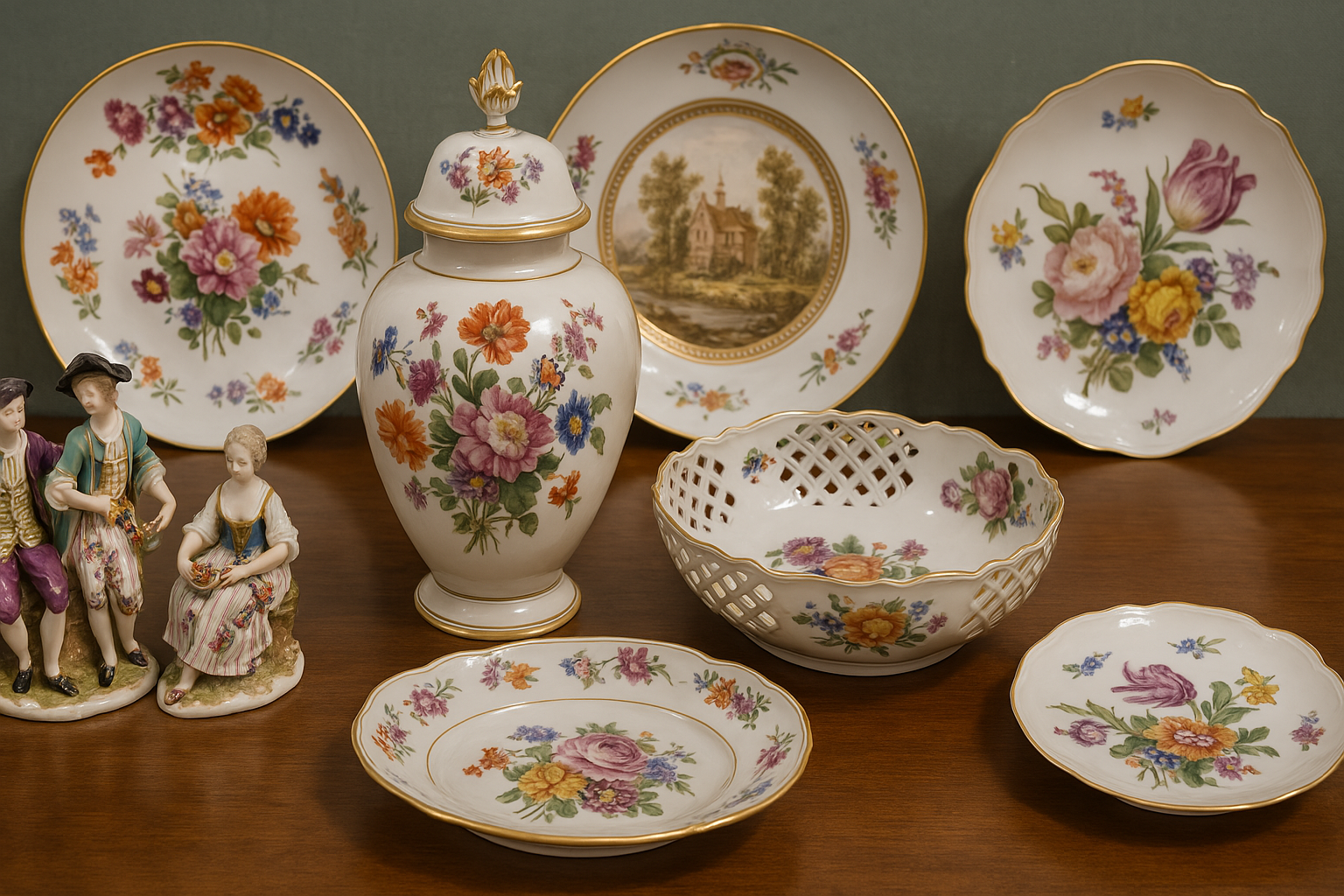
Fragile, luminous, and as light as a seashell, yet steeped in history, symbolism, and refinement: antique porcelain pieces are more than just decorative objects. They are veritable works of art that tell of centuries of taste, innovation, and power. For collectors, they represent one of the most fascinating – and complex – fields in the world of antiques, where beauty intertwines with technical skill and rarity can command immense value.
Unlike other types of antiques, porcelain stands out for having a dual nature: an aesthetic side, tied to its design, form, and color palette, and a technical and productive side, involving the quality of the paste, the brilliance of the glaze, the durability, and the precision of the decorations. This fusion of art and craftsmanship is precisely what has made porcelain one of the most coveted materials by courts, noble families, and collectors since its first appearance in Europe in the 18th century.
When discussing sought-after antique porcelain, we must begin with Meissen, the first European manufacturer capable of replicating the Eastern secret of hard-paste porcelain. Founded in Saxony in 1710, Meissen porcelain is synonymous with absolute quality. Its early models, inspired by Chinese and Japanese ceramics, quickly evolved into original creations, featuring rococo figures, tableware, decorative elements, and small figurative masterpieces. Collectors seek pieces from the early decades, recognizable by the crossed swords mark, as well as by their pictorial refinement and delicate colors.
Another essential name is Sèvres, in France, inextricably linked to the court of Louis XV and Madame de Pompadour. Sèvres porcelain is celebrated for its perfect forms and refined floral decorations, as well as for its famous ground colors, including bleu céleste, rose Pompadour, and apple green. Collectors value not only complete services but also individual cups, dessert plates, plaques, and decorative elements. Each piece is numbered, dated, and often signed by the artist, a detail that facilitates traceability and valuation.
In England, the key name is undoubtedly Wedgwood, which, while not producing porcelain in the strictest sense, profoundly shaped the history of fine ceramics. Their famous blue and white or green and white “jasperware,” with neoclassical motifs in relief, are among the most recognizable and desired pieces, especially when accompanied by historical documentation. Other highly regarded English manufacturers include Worcester, Chelsea, and Derby, each with its unique characteristics and a specific golden age.
But Europe is not the only continent to have left a lasting mark. In fact, it all began much further back: Chinese porcelain, particularly that of the Ming and Qing dynasties, still represents the pinnacle of international collecting. Vases, bowls, plates, statuettes, and even small pieces of furniture decorated with blue and white enamels, calligraphic motifs, court scenes, or cosmological symbols are the subject of million-dollar auctions and meticulous studies. The most experienced collectors recognize the quality by the feel, the sound, the transparency of the paste, and the type of glaze.
Other Asian productions of great fascination are those of Japan, such as Imari and Arita porcelains, with their vibrant colors and layered decorations in gold, iron red, and cobalt blue. In Italy, although the country was more closely tied to maiolica, there are examples of the highest quality, such as Capodimonte porcelain, founded in 1743 under Charles of Bourbon, and continued in Naples, often featuring floral motifs and finely modeled pastoral scenes.
What makes these porcelains so desirable is not only their aesthetic appearance but also their history. Every tea set that belonged to a 19th-century lady, every table figurine created for a court dinner, every commemorative plate produced for a royal event, carries with it a story that intertwines with the history of Europe and the world.
For collectors, therefore, porcelain is much more than an object: it is a piece of the past, a noble, refined material, capable of maintaining its aura even if fragile, sometimes chipped, sometimes cracked. It is precisely this fragility that makes it precious: every piece that has come down to us has survived time, moves, domestic accidents, and carries with it a sense of silent permanence, of preserved beauty.
Recognizing, collecting, and protecting antique porcelain requires an eye, experience, but also sensitivity. And perhaps that is why those who start collecting it rarely stop: once you have learned to read the subtle white of the glaze, the precision of a floral decoration, the levity of a hand-modeled figure, it is impossible to go back.