

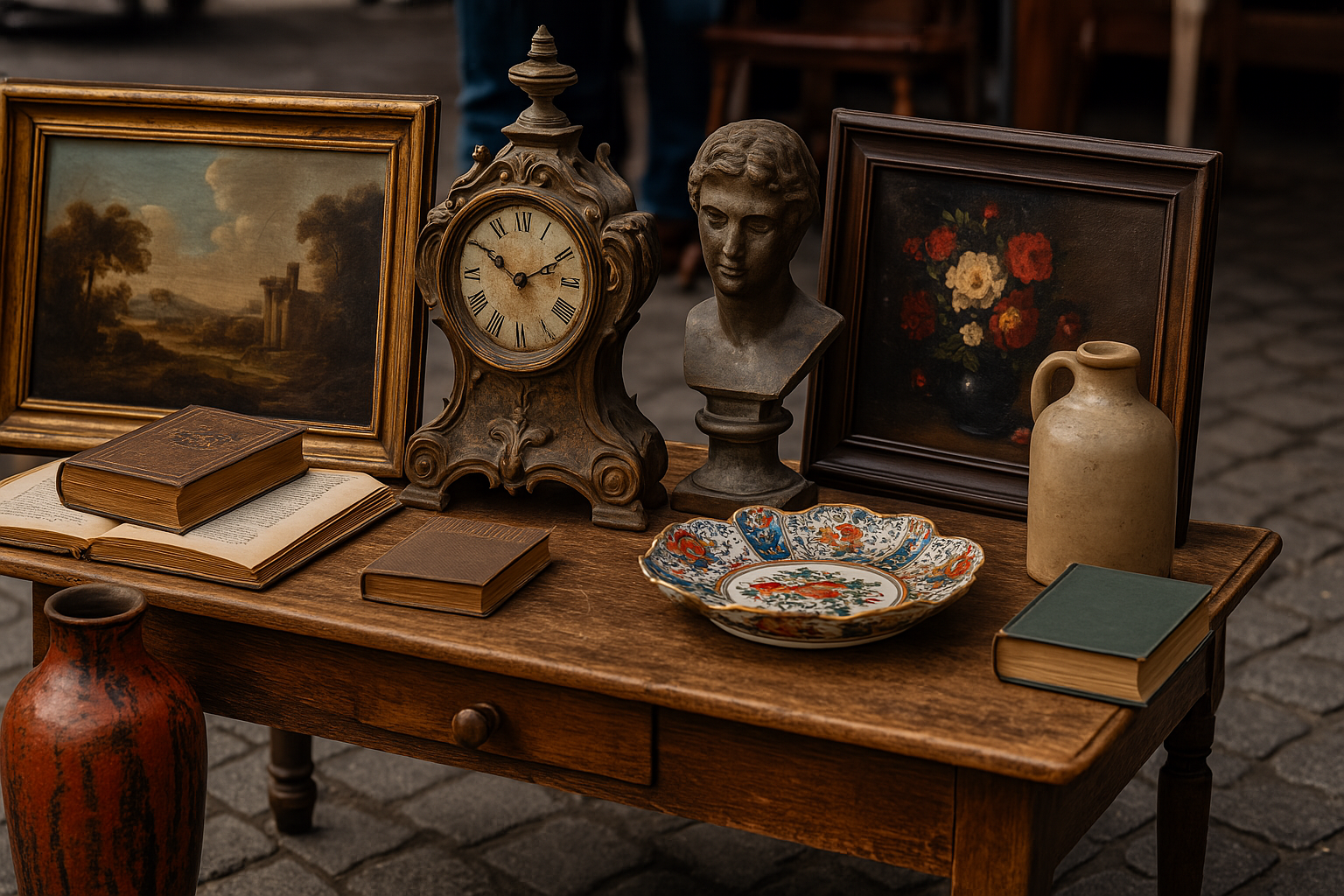
Wandering through the stalls of a flea market is an experience that combines the thrill of discovery with the excitement of the unexpected. Objects are piled up seemingly without order: old frames, yellowed books, forgotten ceramics, vinyl records, childhood toys, small pieces of furniture with the wood worn by time. But behind this apparent chaos often lies extraordinary potential. Amazing stories tell of purchases made for a few euros that turned out to be vintage treasures, capable of changing the lives of those who found them. Some seem straight out of a novel, yet they are true. And for this reason, they are even more fascinating.
One of the most famous cases is that of a photograph purchased at a California flea market for just two dollars. Apparently anonymous, it showed a group of men playing croquet. But an attentive collector noticed something familiar in the features of one of them. After years of research and comparisons, it was discovered that the face belonged to Billy the Kid, the legendary outlaw of the Wild West. The photograph, one of a kind, was then valued at over five million dollars. The discovery, which happened almost by chance, confirms how important an expert eye is… and a little bit of luck.
But the surprises aren’t just in the world of photography. Another famous episode involved a canvas purchased for a few euros at a charity sale in England. The scene depicted wasn’t particularly striking: a rural landscape with barely sketched figures. But the quality of the brushstroke caught the attention of a restorer, who submitted it to analysis. The result was shocking: it was a work attributable to John Constable, one of the greatest English Romantic painters. The market value? Several hundred thousand pounds.
Books can also turn out to be hidden mines. An American boy, rummaging through a box of old volumes, came across a first edition of Thoreau’s “Walden” from 1854, with handwritten notes in the margin. But they weren’t just any notes: they were personal notes by the philosopher himself. The book, bought for a few dollars, ended up in a prestigious university library, which recognized its priceless historical value.
Sometimes, the treasure is hidden in an everyday object. In Germany, a woman bought a Chinese vase for a few euros at a flea market, used as a container for ladles. Unaware of its origin, she took it home, until a friend with a passion for Asian art noticed it and suggested having it evaluated. The vase turned out to be an imperial piece from the Qing dynasty, dating back to the 18th century, decorated with exquisite cloisonné enamels. It was sold at auction for over a million euros.
Italy has its share of similar episodes. In Turin, an old religious print found in a neighborhood market turned out to be an original 16th-century woodcut, probably made in Dürer’s circle. In Rome, a wooden crucifix purchased at a street stall was later recognized as the work of a late Baroque Neapolitan workshop, and is now on display in a restored private chapel.
What makes these stories so fascinating is not only the economic value of the objects found, but their power to overturn expectations. They teach us that time does not erase value, it hides it. And that even the most anonymous object can be the silent bearer of an important story, of an era, of a forgotten signature.
Of course, not all finds lead to million-dollar fortunes. But even a small object, discovered by chance, can have an unexpected historical, emotional, or collectible value. For this reason, every flea market is fertile ground for antique enthusiasts, curiosity hunters, and budding collectors. The secret is to train your eye, to learn to observe, to touch, to ask yourself: “where does it come from? who made it? why did it end up here?”
Because sometimes, between a chipped cup and a blackened frame, lies a forgotten fragment of greatness, ready to reveal itself to those who have curious eyes to see it.