

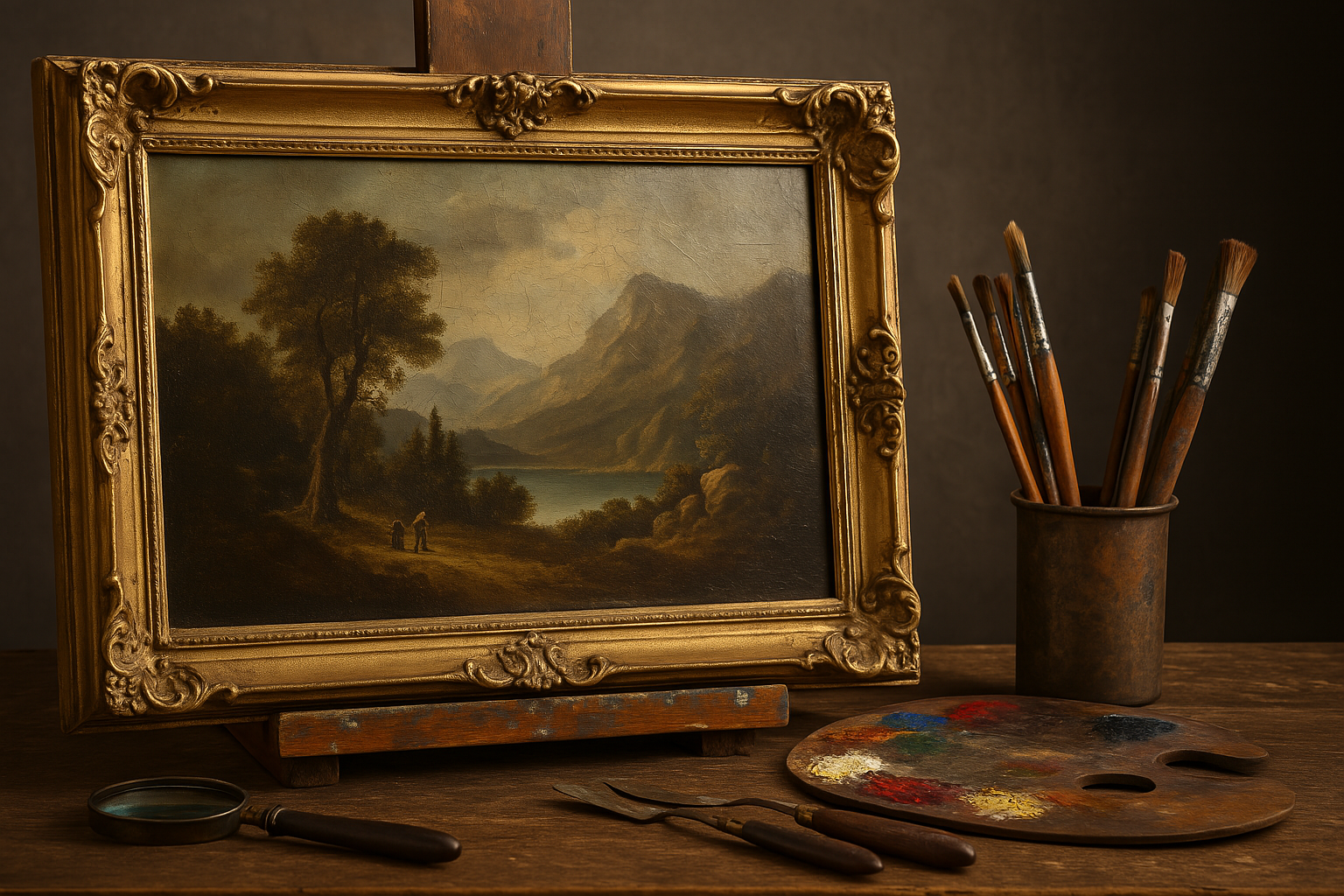
In the world of antiques, few things are as captivating as an antique painting. The patina of time, the depth of color, the intensity of a gaze captured centuries ago—each painting carries a distinct aura. Yet, precisely because of its allure and often high value, antique painting is also highly susceptible to forgeries, reinterpretations, and imitations. Knowing how to distinguish an vintage artwork from a copy—or an outright fake—is therefore an art that requires study, sensitivity, and, above all, a well-trained eye to read the signs of time.
Contrary to what one might think, authenticity is not solely determined by technical instruments. The primary tool is the eye. An eye accustomed to seeing original works in museums, collections, and galleries learns to recognize certain proportions, a certain freedom in the painterly gesture, and a coherence between the support and the technique that is difficult to simulate. But the eye, to be effective, must be cultivated. Visiting exhibitions, studying catalogues raisonnés, and comparing similar works help develop that essential sensitivity for the informed collector.
The analysis of the support is one of the first indicators of authenticity. An antique painting on canvas shows evident signs of age: irregularities in the weave, natural chromatic alterations, and cracks due to the drying of pigments. The back can also reveal much: an old canvas will have a browned color, perhaps remnants of relining, old exhibition labels, or contemporary frames. Conversely, many modern copies are executed on new canvases that are too regular, sometimes artificially aged with varnishes or abrasions.
The paint itself reveals a great deal. The pigments used in the past had a different chemical composition from those used today. Lead white, for example, was common until the 19th century, while titanium white is modern. The expert eye can also perceive differences in saturation and light reflection: antique colors tend to have a warmer, less uniform tone, with irregular transparencies due to wear and oxidation.
One of the most difficult traits to simulate is the craquelure, the fine network of micro-fractures on the paint surface that forms over time. This phenomenon occurs naturally as materials age, especially if the work has been exposed to light, humidity, or subject to minor movements of the support. Techniques exist to mimic craquelure, but they often appear too regular, unnatural, and visible only on the surface, not in depth. An vintage craquelure, on the other hand, follows the internal logic of the painting: it adapts to the brushstrokes, is interrupted at points of restoration, and varies from area to area.
The signature, if present, should also be read carefully. Not so much to verify its presence—many antique paintings are unsigned—but to assess its consistency, technique, and integration into the painting. An uncertain signature, too prominently displayed, applied with modern pigments, or misaligned with the composition, is often a later addition. The same applies to titles, dates, and dedications on the back: they are useful but never a guarantee in themselves.
Documented provenance is one of the most solid criteria for approaching the truth about a work. A work that has passed through reputable galleries, auction houses, public collections, or that has participated in exhibitions, publications, and scientific studies has a traceability that lends it credibility. This information is not always available, but when it is, it is an essential element in assessing authenticity.
And then there is the matter of restoration. Many antique paintings have been restored, sometimes more than once. A well-done restoration can preserve a work, but an excessive or poorly executed restoration can compromise the interpretation of authenticity. Forgers often hide behind old varnishes, fictitious “cleanings”, or layers deliberately damaged to mask a modern hand.
In case of doubt, the best advice is always to consult an expert: restorers, art historians, technical experts, or reliable auction houses. Technology can also help: radiographic analyses, chemical investigations of pigments, infrared reflectography, and analysis of the paint binder are increasingly accessible tools that can resolve many doubts. But technology alone is not enough if it is not accompanied by a historical, stylistic and material understanding.
Distinguishing an vintage antique painting from a copy is not just a technical matter: it is an act of listening, comparing, and respecting the material and its history. An vintage work speaks not only with the image it represents, but with every centimeter of its surface, every layer of color, every imperfection. And those who know how to read all this possess not only a tool to avoid scams, but a key to truly entering the heart of antique art.