

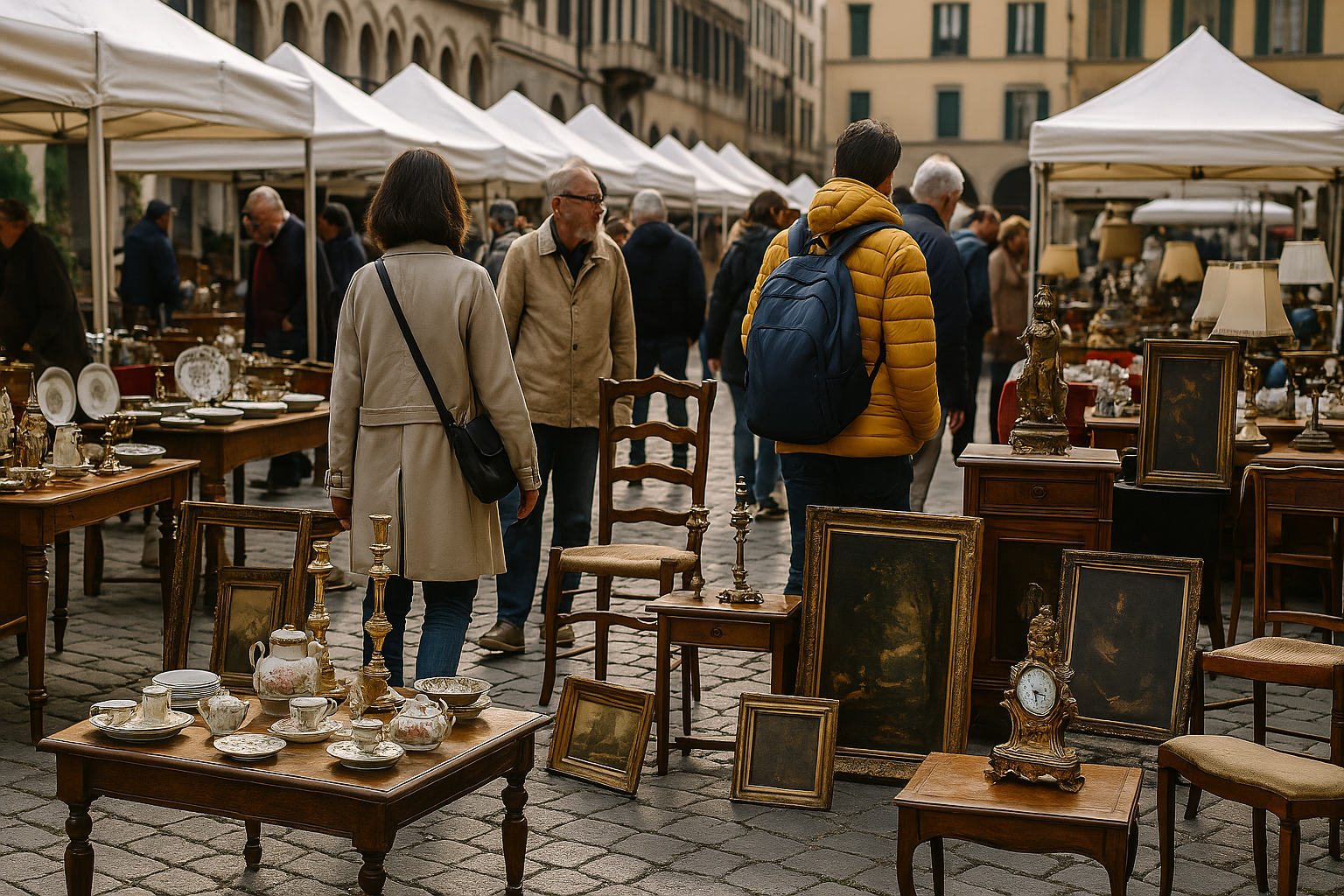
There are places where time seems to unfold slowly, where every object tells a story, and each step among the stalls becomes a discovery. Antique markets, in this sense, represent much more than simple trading posts: they are true stages of collective memory, where the material history of humanity blends with individual curiosity, and where the act of buying takes on a profound cultural meaning. It’s not just about finding a bargain, but about establishing a dialogue with the past.
Anyone who regularly visits an antique market knows this well: each edition is different from the last. The objects change, the vendors vary, the people alternate. Yet, there is always a constant: that subtle sense of anticipation and wonder, the idea that you can hold an vintage fragment of another era in your hands. From early twentieth-century crockery to out-of-print books, from handcrafted furniture to black and white photographs forgotten in a box, everything found in antique markets possesses a double life: the one it has lived and the one it can relive, if only someone recognizes its value.
In Italy, the homeland of art and artisan tradition, antique markets are distributed across a vast cultural map. Some are monthly appointments, others annual events that attract thousands of enthusiasts from around the world. The Arezzo Antique Fair, active since 1968, is considered the most important event of its kind nationally. Every first Sunday of the month (and the preceding Saturday), the Tuscan city transforms into a huge open-air exhibition, where antique dealers, junk dealers, and restorers offer selected, and sometimes surprising, objects for variety and rarity. Walking among the stalls that wind around Piazza Grande means immersing yourself in centuries of domestic and artistic history, among mirrors, chests, clocks, Murano glass, and porcelain.
Equally evocative is the Antique Market on the Naviglio Grande in Milan. Here, the atmosphere is completely different, more urban, more dynamic, but no less fascinating. Along the canal, every last Sunday of the month, hundreds of stalls stretch out, offering not only antiques, but also vintage modern objects, vintage design, and rare collectibles. The environment is lively, animated by enthusiasts, interior designers, young creatives, and curious tourists.
Among the unmissable events is also Mercanteinfiera in Parma, a true international fair that takes place twice a year, in spring and autumn. Here, antiques meet professionalism: the pavilions host antique dealers from all over Europe, with carefully curated stands and selected objects. The environment is more expository than market-like, but the offer is of the highest level, and the organization allows for ideal enjoyment even for those who are just starting out.
Italy boasts dozens of smaller but very characteristic markets: from Piazza dei Ciompi in Florence to Borgo Cavour in Treviso, passing through Lucca, Modena, Verona, Piazza Diaz in Lecco, each region has its own events, often linked to local traditions and the recovery of historic squares as a place of cultural as well as commercial exchange.
Beyond the borders, the charm of antique markets is expressed in different but equally engaging forms. Paris, for example, is the world capital of brocante: the Marché aux Puces de Saint-Ouen, with its more than 1,700 exhibitors, is a true labyrinth of shops and courtyards that require time, patience, and a certain predisposition to exploration. It is easy to get lost among different eras, among nineteenth-century furnishings and Art Deco objects, among vintage clothes and Napoleonic engravings.
In London, the famous Portobello Road Market offers a more lively and colorful experience. In addition to antiques, you can find curiosities of all kinds, coins, maps, antique glass, clocks, jewelry, and musical instruments. Here, the ethnographic and colonial component is very present, reflecting the complexity of British history.
In Belgium, Place du Jeu de Balle in Brussels is a market with a more “popular” spirit, where an unexpected treasure can sprout between a chipped cup and an old-fashioned radio. The same goes for Berlin, with its Mauerpark, or for the port cities of Spain, such as Barcelona and Valencia, where the culture of the market merges with that of reuse and sustainability.
Further afield, Buenos Aires surprises with the San Telmo market, where the European heritage blends with local traditions. Here, between a Viennese chair and a set of English cutlery, you will also find objects from Argentine history, Peronist memorabilia, pieces of South American modernism.
But what makes these places truly special? The fact that they are, first of all, meeting spaces. In an antique market, you confront, talk, and learn. Every exhibited object has a voice, but it is the words of the vendors, customers, and enthusiasts that reveal its meaning. Moving from one stall to another is a journey through family stories, city tales, artisan techniques, and bygone eras.
And in the end, you never come home with just an object. You come back with a different idea of time, with the feeling of having touched something that survives consumption, speed, and homogenization. Because in antique markets, what counts is not so much what you buy, but what you recover: the opportunity to live surrounded by stories, to recognize yourself in a material that has already lived and is ready to do so again.