

The Magnetic Charm of Ivory and Jade: Why They Belong in Your Collection
✨ Selected Pieces from the AnticoAntico Collection
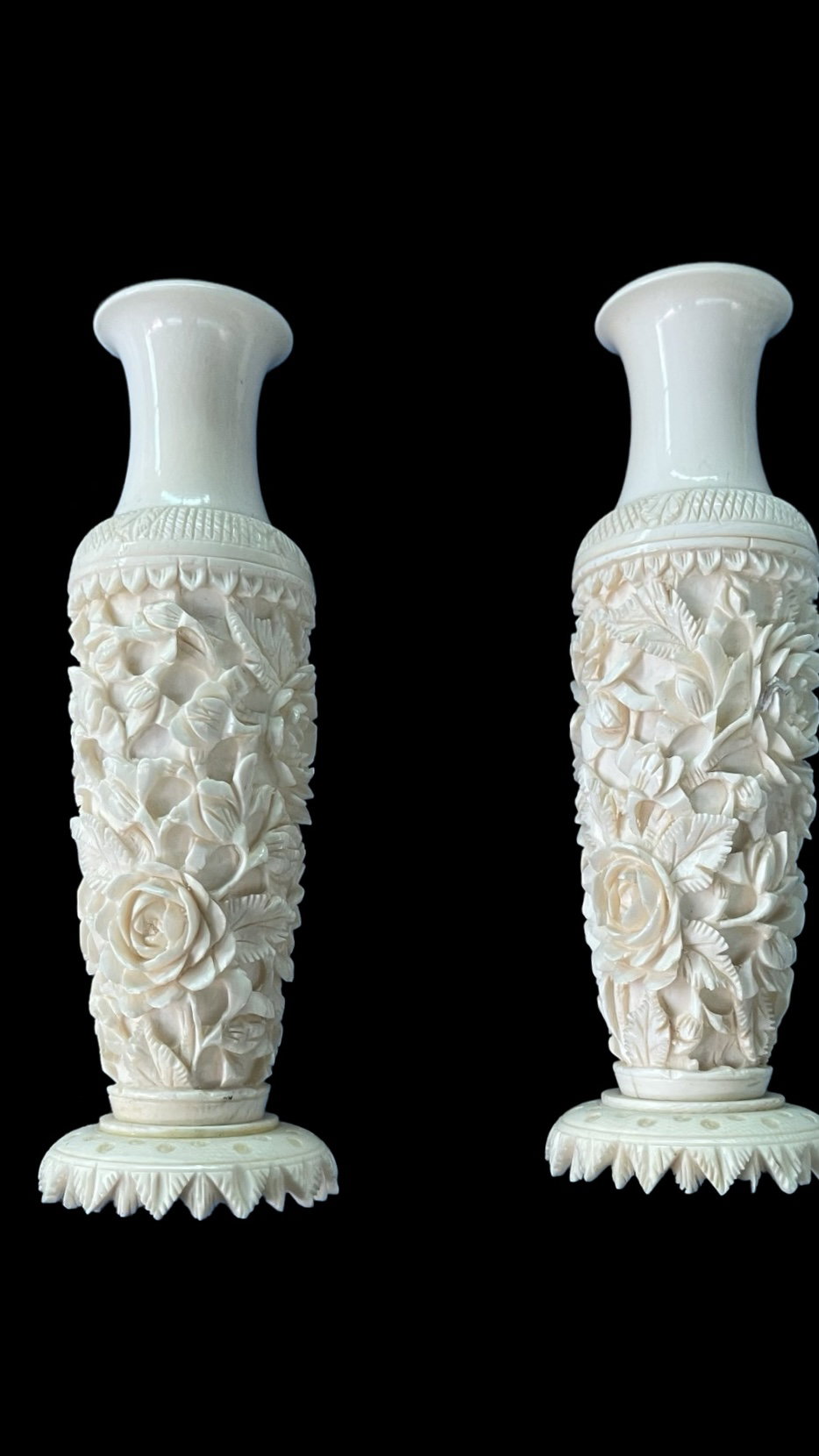
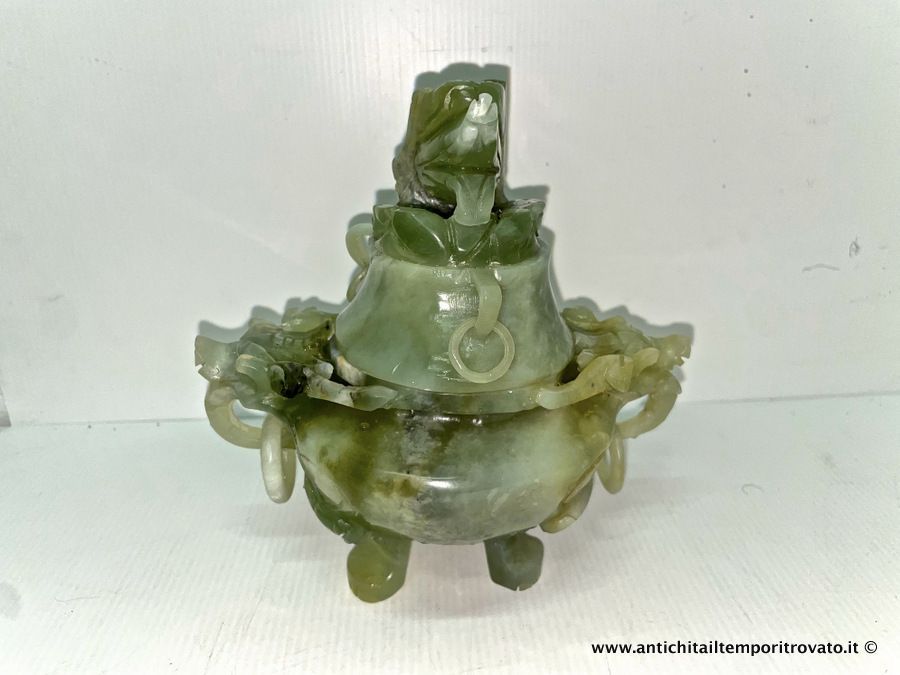

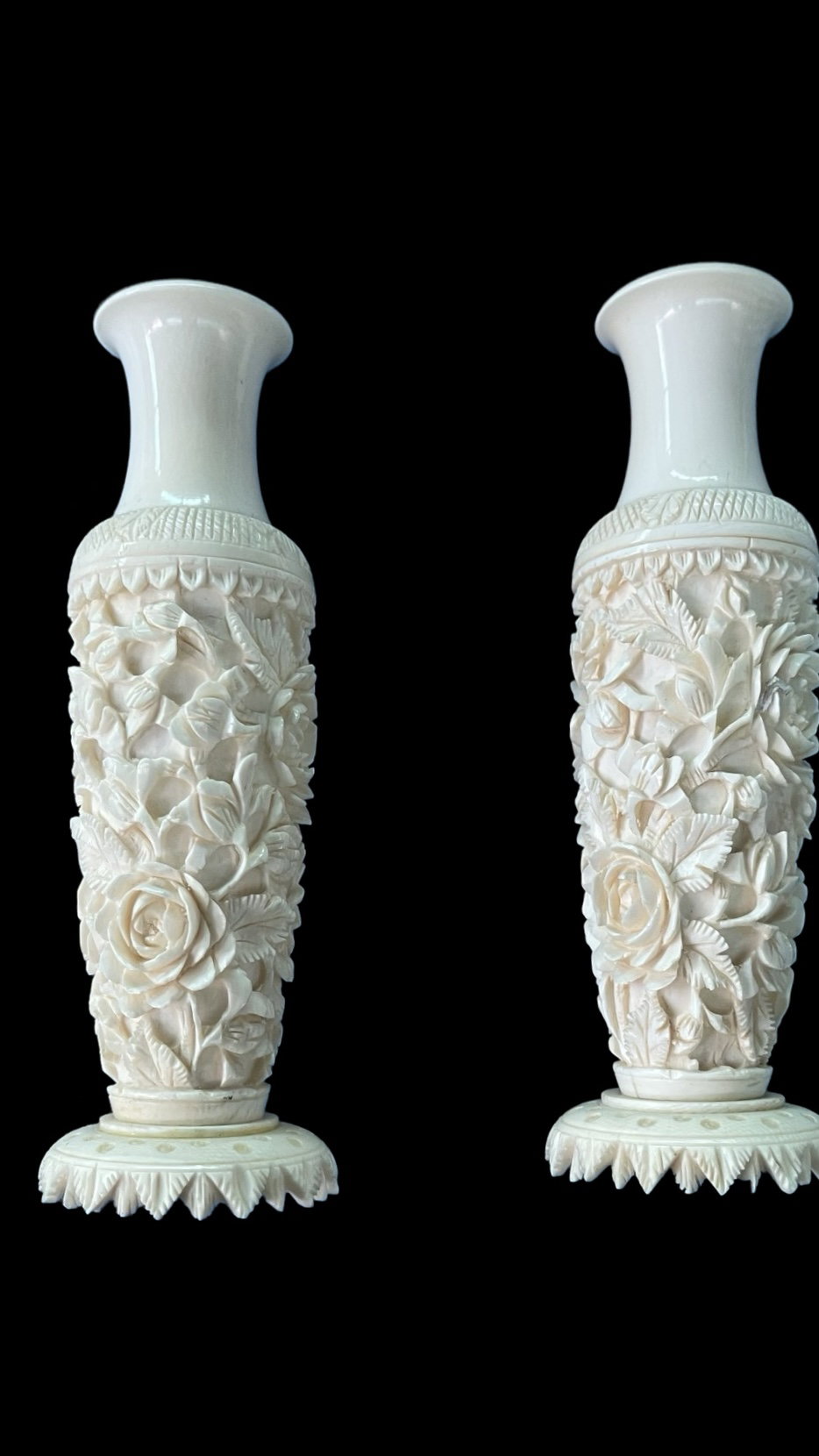
There is a quiet magnetism that emanates from certain objects—a pull that bypasses the rational mind and speaks directly to something older, deeper, and infinitely more mysterious. Antique ivory and jade possess exactly that kind of gravity. They are not merely materials; they are compressed civilizations, each piece carrying the breath of the artisan who shaped it, the emperor who coveted it, the trader who risked his life to move it across empires, and the collector who, like you, recognized its singular hold. To collect antique ivory and jade is to participate in a dialogue with history that spans five millennia and three continents. It is a sensual experience—the cool, dense weight of a nephrite bi disc in your palm, the impossibly luminous patina of a carved ivory netsuke that has been handled by generations of knowing fingers. These objects demand patience, scholarship, and a certain poetic temperament. But for those who yield to their pull, they offer something far rarer than monetary return: a tangible kinship with the dead and the divine.
Ivory: The White Gold of Empires, the Sculptor’s Obsession
Long before gold and diamonds claimed the trophy shelf of human desire, ivory was the material that made civilizations gasp. The ancient Egyptians called it abu, and they carved it into flabellum fans and ceremonial scepters for pharaohs who believed the hippopotamus tusk held the chaotic energy of the Nile itself, tamed and re-routed into sovereign power. By the fourth century A.D., the Romans had turned ivory into a political weapon—the diptych, a pair of hinged ivory panels presented by consuls to the Roman elite, inscribed with their names and carved with allegorical imagery. Owning one was not merely a luxury; it was an announcement that you belonged to the ruling class. When the Western Empire fell, these diptychs survived the sack of cities, the passage of barbarian tribes, and religious upheavals, becoming the Rosetta Stones of late antique art. They are among the most sought-after treasures in the market today—and they are but the opening chapter.
Consider the East. In Japan, during the Edo period, a merchant class rose to wealth that social law forbade them from displaying in silk and gold. So they turned inward, to a miniature universe carved from the tusk: the netsuke. These tiny toggle buttons, worn on the sash of the kimono, depicted gods, demons, lovers, and beasts with a fidelity that teeters on the supernatural. The great master Okatomo would spend months on a single tiger, rendering each hair with microscopic precision, knowing that a wealthy merchant’s hand would touch it daily. The intimacy of this craft—the fact that these pieces were meant to be touched, rotated, and appreciated in the palm—gives antique netsuke an almost erotic warmth. In China, meanwhile, the imagination took a different turn: the craftsmen of Guangzhou developed the “devil’s workballs,” concentric ivory spheres nested one inside another, each one perforated with elaborate geometric latticework and entirely carved from a single tusk using a lathe and a set of angled chisels. A Qing-dynasty ball with twenty-four internal layers could take an artisan’s entire lifetime to complete. The Europeans who first saw these marvels refused to believe they were man-made; they insisted on supernatural intervention. That incredulity is precisely what makes owning an antique ivory piece so thrilling—you are holding proof that human hands, alone, can rival the divine.
When the global ivory trade was banned in 1989 under CITES, the market for antique ivory—defined as pre-1947 or legally attested older pieces—was thrown into a paradoxical golden age. The ban, designed to save endangered elephants, had the unintended effect of turning existing antique ivory into a fiercely protected asset. Today, a well-provenanced French Dieppe carving from the 1830s, or an Edo-period netsuke of a mythical fox-woman, commands prices that reflect not just its artistry but its grandfathered legal status. The savvy collector understands this deeply: to acquire antique ivory with verified provenance is to own a piece of history that can no longer be made, ever again, by any hands on Earth.
Jade: The Stone of Heaven, the Mirror of Virtue
If ivory is the white gold of empires, jade is the soul of Chinese civilization. Confucius, writing in the fifth century B.C., assigned jade eleven virtues—warmth as benevolence, transparency as sincerity, the sound it makes when struck as wisdom, its resilience as fortitude. He wrote that wise men wear jade close to their skin because “where there is jade, there is virtue.” This was not decorative philosophy; it was state doctrine. For over three thousand years, from the Neolithic Hongshan culture of 3500 B.C. to the fall of the Qing dynasty in 1912, jade was reserved for the emperor and his highest ministers. The bi disc—a flat, circular ring with a central hole—was the ritual object par excellence, symbolizing the dome of the heavens. It was so sacred that it was not merely used in ceremonies; it accompanied the dead into the afterlife.
Nowhere was this belief more materially demonstrated than in the tomb of Prince Liu Sheng, who died in 113 B.C. when the Han dynasty was at its zenith. His body was entombed in a jade burial suit: 2,498 individual pieces of nephrite jade, each one sanded to a mirror finish and sewn together with over two kilometers of gold thread. The Chinese believed that jade would prevent the decomposition of the body—a belief so strong that entire workshops spent over a decade constructing a single suit. When archaeologists unearthed it in 1968 near Hebei, they found that the gold thread had held, the jade had glowed with its original luminous luster, and the prince’s body had dissolved to dust centuries earlier. The contradiction does not diminish the piece’s power; it deepens it. The jade did not preserve the flesh, but it preserved the idea of the man, his status, and his civilization’s greatest craft.
The craftsmanship of jade is fundamentally different from ivory carving. Jade—whether nephrite, the tougher and more ancient form, or jadeite, the imperial green variety imported from Burma in the eighteenth century—cannot be carved with chisels or knives. It is lapidary work through and through: the artisan uses abrasives, such as crushed garnet or corundum, to grind the stone against copper disks spinning at high speed, a process so slow that cutting a single large block could take two years. This is why the Qianlong Emperor, the great Qing ruler of the eighteenth century, called jade “the stone of heaven.” He was perhaps the most obsessive jade collector ever to live—his personal inventory listed over 10,000 pieces. He composed poetry about individual jade carvings, demanded that his master artisans produce new techniques, and was so entranced by the nephrite boulders sent as tribute from the Khotan region in Central Asia that he ordered entire pavilions built to house them. To walk through a room of Qianlong’s jade collection is to walk through a mind that equated beauty with moral order.
What draws the modern collector to these stones is not merely their ancient pedigree, but their timeless physical language. A Qi dynasty jade axe head, polished to a silvery gleam, is an object of austere modernism that could hang in the Tate. A Qing jadeite snuff bottle, striated with violet and apple green, is a symphony of color and glaze that rivals any painting. The value of antique jade has climbed steadily for three decades, driven by a resurgent China that sees these objects as the key to its own cultural memory. Yet the market remains full of opportunity for the discerning eye—pieces of exceptional craftsmanship still surface in estate sales and private collections, priced far below their auction potential because the seller does not understand the stone’s provenance or the depth of its tradition.
When you bring an antique ivory or jade piece into your home—whether it is a modest 19th-century Canton ivory figural group or a Sung dynasty white jade ornament—you are not merely decorating a room. You are assuming responsibility for a story that began in a Nile swamp, a Himalayan quarry, a Japanese merchant’s workshop, or a Qing imperial atelier. It is a story of obsession, craft, ritual, and love. Few objects in the antique world can match that depth of narrative. This is why these two materials, so different in their essence, belong side by side in any serious collection: they are the alpha and omega of material culture, the white gold of the West and the stone of heaven of the East. To hold them is to hold the world. And to begin that journey, you may wish to explore our curated collection of antique ivory and jade pieces—where each object has been vetted for authenticity, legality, and the kind of soul-stirring provenance that marks a truly magnetic acquisition.
\n\n
The Artisan’s Signature: How to Read the Craftsmanship in Every Piece
For the serious collector, the difference between a merely old object and a true masterpiece is not found in age alone, nor in the purity of the material. It is found in the invisible conversation between the artisan’s hand and the unforgiving medium. Both ivory and jade present extreme challenges: ivory, with its layered, fibrous structure, and jade, as one of the toughest minerals on earth—so dense that steel blades will barely scratch it, and only abrasive powders and relentless patience can shape it. When you hold a piece of antique ivory or jade, you are holding a record of thousands of hours of controlled risk. The artisan could not afford a single miscalculation. A slip of the drill in a Qing-dynasty jade vase meant months of lost work and a ruined block of nephrite that was more valuable than gold. In this chapter, we will learn to read those marks of courage and mastery, to see the signature that no artist ever signed.
The Language of the Tool: What the ‘Underneath’ Reveals
Every culture that worked with ivory and jade used distinctive tools, and those tools leave distinctive signatures. In seventeenth-century Dieppe, France, a renowned center of ivory carving, artisans used fine wire saws and hand-turned lathes; the internal surfaces of their intricate boxes often show tiny, uniform concentric grooves, evidence of a steady hand against a bow-driven lathe. A century later, in Germany’s Erzgebirge region, carvers used a “Drehbank” and sharpened gravers at a precise 45-degree angle, leaving sharp, crisp undercuts. If you can look inside an ivory tankard or cigar case with a jeweler’s loupe and find tiny, irregular striations that no single tool could make, you are likely looking at modern power-burr work, which spins evenly and leaves smooth, slightly fuzzy edges—a dead giveaway of a later reproduction.
With jade, the language is even more telling. Pre-mechanical jade workshops in Suzhou and Beijing used a foot-powered “bangle mill” and garnet or quartz sand abrasives, sometimes in conjunction with wooden, bamboo, or iron tools. Because the abrasive was loose, the carving was essentially a slow, grinding erosion process. This leaves a characteristically soft, dimpled texture in the deepest carvings—what Chinese connoisseurs call “orange peel” (juzi pi). The edges of any cut will be slightly rounded, not sharp. This is the single most important hallmark of authentic antique jade: no high-speed steel tool can reproduce that gentle, almost water-worn finish. If the lines are razor-sharp and the internal corners are crisply squared, it was almost certainly cut with modern diamond burrs, regardless of how convincingly old the surface patina may appear. For those looking to build a serious collection, understanding this tactile distinction is the difference between owning history and owning a souvenir. The best way to train your eye is to study certified authentic antique ivory and jade pieces where the provenance and tool marks are documented, which you can explore within the curated antique ivory and jade collectibles offerings of specialist dealers.
The Patina of Time: Reading Surface and Age
Ivory and jade do not age like wood or silver; they age like skin. Ivory is a protein-based material, and over decades it slowly dehydrates and absorbs its surroundings. This produces a character called “crazing”—a fine, microscopic network of cracks that looks like the tiny fissures on an old oil painting. True antique ivory has this crackle over most of its surface, and it also develops a warm honey or walnut-brown tone at the exposed points, graduating to a lighter champagne color in the protected recesses. Crucially, this darkening is natural and irregular. Be suspicious of pieces with an all-over uniform tan or a single dark patch in a groove; these are often the result of a deliberate amber-tone dye or using a tea bath. Genuine age will be distorted and unpredictable, like freckles.
Jade patina is a subtler but equally beautiful story. Nephrite jade, the material of ancient China, is composed of interlocking fibrous crystals that give it an incredible toughness. Even after 2,000 years in a tomb, its surface ultimate develops a lustrous, almost oily “glass-like” sheen, called baoguang (wrapped light). This sheen is not a coating; it is the result of the material being slowly polished by the hands of its owners, almost like human skin polished by a ring. If you gently tilt a truly antique jade bi disc under a light, you’ll see the sheen catches at many tiny points, creating a soft, fragmented glimmer. A modern piece, polished with high-speed mechanical buffs, shows a bright, continuous, almost plasticky reflection. Moreover, old jade is often “wet” in a certain way—the natural mineral traces and slight striations provide a depth that looks like fog trapped inside ice.
The Composition’s Logic: When Craftsmanship Tells a Cultural Story
How the artisan organized the subject matter is as revealing as the tool marks. In Japanese netsuke carving of the Edo period, master artisans such as Kaigyokusai Matsuga (1813–1852) carved into elephant ivory with such fluidity that the form seems to move with you. The masters had a compositional logic: they would always preserve the natural taper of the tusk, placing the most complex and fragile details at the base, away from the stress of the top hole. They also understood “negative space” perfectly—piercings were not just decoration; they were structural reliefs that allowed the ivory to dry and contract without cracking. A well-carved netsuke shows logic between the hole, the strength of the tusk, and the visual center.
In Chinese jade, the composition of the “mountain” carvings—vast landscapes carved from a single boulder—was dictated by the internal geology of the mineral itself. A master carver would spend months studying the raw stone, mapping where the impurities (weishi) and green veins (mi) flowed. If a small fissure threatened to split the piece, the artisan would transform the flaw into a waterfall or a cascading pine branch. As you study a piece, look for these “problem-solving” moments. If you see an elaborate wave pattern emerging directly from an area of brown striations or an amazingly unrelated flower carved over a spot of tough quartz, you are read the artisan’s solution to a potential break—a signature of pure genius. This is the real poetry of craftsmanship: the maker’s decisions born of chaos.
When you hold a piece of jade and let the light play across its surface, you are not just testing its authenticity; you are listening to the echo of a calloused hand, a foot on a pedal, and the faint metallic purr of a bow-driven drill. The artisan’s signature is everywhere—in the slightly curved line, the gentle bead inside a crevice, the military discipline of a carved prayer that takes a tiny detour around a stubborn mineral vein. Learn to read those signs, and you will never need a certificate to know you are in the presence of a masterpiece.\n\n
A Journey Through Civilizations: From Ancient Rituals to Victorian Display
To truly understand the allure of collecting antique ivory and jade pieces, one must first abandon the modern notion of these materials as mere decorative commodities. For millennia, ivory and jade were not simply prized for their beauty; they were considered conduits to the divine, status symbols of immense power, and talismans against the unknown. Their history is a sprawling narrative that touches every great civilization on Earth, and tracing that journey is essential for any serious collector who wishes to distinguish a courtly artifact from a mere souvenir.
Sacred Beginnings: The Cosmology of Jade and Ivory in the Ancient World
Our story begins not in a marketplace, but in the ritual centers of the Neolithic world. In ancient China, long before the Great Wall was ever conceived, jade (or *yu*) was being worked with astonishing precision. The Liangzhu culture (c. 3300–2300 BC) crafted large ceremonial blades (*zhang*) and the iconic *cong*—a square tube with a circular inner bore representing the connection between earth and heaven. These pieces were not decorative; they were the sacred hardware of shamans and kings. The physical properties of jade—its incredible toughness, its coolness to the touch, and its resonant bell-like sound when struck—led the Chinese to believe it possessed immortality and protective qualities. This belief was so profound that jade was placed in the orifices of the deceased, and even full burial suits made of thousands of jade plaques were sewn with gold wire for Han Dynasty princes, intended to preserve the body for eternity.
Simultaneously, across the Pacific in Mesoamerica, jade was prized even above gold by the Olmec, Maya, and Aztec. The Maya referred to it as the “supreme stone,” associating its green hues with life, water, and the feathered serpent god Quetzalcoatl. Jade beads, ear ornaments, and inlaid teeth were marks of nobility, while small jade figures carved with elaborate iconography served as offerings in sacred cenotes. In this hemisphere, jade wasn’t just a stone; it was a condensed form of the life-giving forces of the world.
The story of antique ivory is equally sacred. In ancient Egypt, the hippopotamus was a creature of the Nile’s fertile chaos. The pharaohs hunted hippos in ritual hunts, and their massive tusks were carved into small apotropaic wands and cosmetic spoons. These objects, like the famous “swimming girl” spoon, were not merely functional. They were believed to transfer the potency of the animal to the user, offering protection during childbirth and the afterlife. Similarly, in the ancient Levant and Indus Valley, ivory from elephants was considered royal booty—a material so prestigious that artisans used the entire tusk to carve intricate furniture panels and cylindrical seals for trade, some of which have been found as far away as Mesopotamia.
Imperial Ambitions: The Silk Road and the Age of Mastery
As trade routes expanded, the spiritual aura of jade and ivory merged with the politics of empire. During the Tang and Song dynasties, jade carving underwent a profound shift. While ritual forms remained, new secular objects emerged—belt plaques, hair ornaments, and refined scholar’s objects like brush washers and seals. The artisans of this era mastered the art of *qiaose* (skillful color utilization), using the naturally occurring russet or brown “skin” of the jade boulder to create visual contrasts within a single carving, such as a cicada or a monkey peering through foliage.
The arrival of the Mongols and the subsequent Pax Mongolica opened a new era of cross-cultural exchange along the Silk Road. This is where the narrative of jade becomes fully globalized. Jade from the Khotan mines in Central Asia flowed westward into Persia and eventually into the heart of the Mughal Empire in India. Under emperors like Jahangir and Shah Jahan, jade reached an apex of technical and artistic sophistication. The Mughal masters carved jade into translucent wine cups, delicate dagger hilts, and boxes so thin they were semitransparent. Their hallmark was the use of *pietra dura* inlay—embedding rubies, emeralds, and gold wire into the hard stone to create floral motifs. If you find a jade piece with these characteristics, you are looking at a relic of one of history’s most ostentatious courts.
Europe did not stand idly by. While jade remained a distant exotic, ivory became the canvas of the medieval Christian world. In the Byzantine Empire and Gothic Europe, ivory diptychs—two hinged panels carved with religious scenes—were produced for personal devotion and as prestigious diplomatic gifts. The “combed” ivory of the Ottomans also became legend. However, the Renaissance and the subsequent Age of Exploration transformed ivory from a purely religious medium into a demonstration of scientific and artistic virtuosity.
The Grand Tour and the Victorian Cabinet of Curiosities
This brings us to the era that directly shaped the market for antique ivory and jade pieces as we know it today: the 18th and 19th centuries. The phenomenon of the European Grand Tour—a rite of passage for wealthy young aristocrats—created an insatiable demand for portable art from China, Japan, and India. No gentleman’s collection was complete without a Chinese jade bowl or an intricate ivory puzzle ball.
By the Victorian era, the world had shrunk. The British and French Empires brought back a staggering array of goods, and the bourgeois home became a stage for displaying the family’s cultivation and global reach. The “cabinet of curiosities” evolved into the parlor display cabinet, filled with jade snuff bottles, ivory netsuke (Japanese toggles), and elaborately carved fans. The Victorians adored the *trompe l’oeil* and the mechanically impossible. They marveled at Chinese ivory concentric spheres—layers upon layers of free-moving balls carved from a single tusk—and at jadeite “Imperial Jade” from Burma, whose vivid emerald green was once reserved exclusively for the Chinese imperial court but now adorned brooches and paper knives for Western ladies.
For the Victorian collector, these objects were more than just investments; they were silent ambassadors of far-off lands, telling stories of ancient rites and imperial grandeur. However, the Victorian era also marks a critical turning point for the modern collector. The high demand led to mass production in Canton and other treaty ports, where artisans created pieces specifically for the Western market. These pieces, while beautiful, lack the ritualistic depth or courtly precision of earlier works.
Understanding this timeline is the first step in navigating the complex world of acquisition. Once you can distinguish a Han Dynasty tomb jade from a Victorian-era export piece, or a Roman carving knife from a Renaissance plaque, you can begin to assess true value and authenticity. To begin exploring the breadth of pieces that have survived from these distinct eras, you can browse a curated selection of antique ivory and jade pieces available in our dedicated category.
The journey from ancient ritual to Victorian display is not just a chronological progression; it is a testament to humanity’s enduring desire to hold onto the sacred and the beautiful in tangible form. Each piece carries the weight of the culture that made it, and it is that weight—that deep historical resonance—that separates a true antique from a mere old thing.\n\n
Protecting Your Investment: Care, Ethics, and Avoiding Fakes
Owning antique ivory and jade is a privilege that carries with it a profound responsibility. Unlike gold or gemstones that can be melted and recut, ivory and jade are organic and semi-organic materials with a memory of their own—they remember the elephant’s tusk, the whale’s tooth, or the mountain from which the nephrite was hewn. To protect your investment, you must become a guardian of that memory. This chapter will guide you through the tripartite challenge of every serious collector: preserving the physical integrity of your pieces, navigating the ethical and legal labyrinth of ivory ownership, and arming yourself against the increasingly sophisticated world of fakes.
The Delicate Art of Preservation: Caring for Ivory and Jade
Ivory is a hydroscopic material, meaning it absorbs and releases moisture from the air. This is both its lifeline and its Achilles’ heel. In the dry, heated homes of Northern Europe, a tusks’ worst enemy is cracking, a condition known as “crazing” or “checking.” The historical record is replete with tales of Victorian-era collectors who lost magnificent scrimshaw pieces to the harsh, coal-fired atmospheres of London drawing rooms. The secret to longevity lies in environmental stability. Ideally, you should display ivory in a room where the relative humidity sits between 45% and 55%—a range that mimics the temperate climates where these objects were originally crafted. Sudden fluctuations are more damaging than a constant, slightly humid environment. If you live in a climate with dramatic seasonal swings, consider investing in a glass display case with a small, unobtrusive humidifier or a dish of silica gel that you can monitor and recondition.
When it comes to cleaning, less is absolutely more. Never submerge ivory in water; the capillary action will draw moisture into the internal structure, causing delamination and warping. Instead, use a soft, dry, natural-bristle brush (a sable artist’s brush is ideal) to gently remove dust. For stubborn grime, a barely damp cotton swab—one that has been blotted on a paper towel until nearly dry—can be used in a single, unidirectional stroke. Crucially, avoid all petroleum-based oils, lemon oils, or commercial polishes. They create a sticky film that attracts dirt and, over time, can yellow the ivory irreversibly. The traditional Japanese approach to caring for ivory netsuke, which my colleagues at antique ivory and jade collectibles often recommend, involves simply rubbing the piece with the palm of the hand—the natural oils of human skin, in small amounts, keep the ivory supple and glowing without any chemical intervention.
Jade, on the other hand, is a study in resilience. With a hardness of between 6 and 7 on the Mohs scale, jade (particularly nephrite) is famously tough—it was used by Neolithic cultures to make axe heads and ceremonial weapons. Yet, this toughness has a caveat: jade is brittle under sharp impact. A jade bangle dropped onto a marble floor can shatter into dozens of pieces, a tragedy that has reduced many a collector to tears. The care for jade is primarily about protection from physical shock and from chemical exposure. Avoid wearing jade jewelry while doing manual work, and never use ultrasonic cleaners or steam cleaners, which can force moisture into microscopic fissures and cloud the stone’s internal structure. To enhance the lustre of a jade carving, a very small amount of pure mineral oil (like a drop of pharmaceutical-grade oil) applied with a soft cloth and then wiped completely dry is acceptable, but many purists prefer a simple buffing with a chamois cloth to bring out the stone’s natural “glow,” known in Chinese connoisseurship as the stone’s “living” surface.
The Ethics of Ivory: Navigating Legal and Moral Terrain
There is no sugar-coating the elephant in the room: the ivory trade is heavily restricted, and for good reason. The decimation of African and Asian elephant populations in the 20th century—from millions to mere hundreds of thousands—is one of the great conservation tragedies of our time. As a collector, you must be scrupulously aware of the legal frameworks that govern your hobby. The Convention on International Trade in Endangered Species (CITES) has, since 1989, banned the commercial international trade in raw elephant ivory. However, the antique exemption is a complex patchwork. In the European Union, where our gallery is based, antique ivory (defined as pre-1947 in some member states, and pre-1975 for certain items) can be traded within the EU, but requires specific documentation and permits for export to non-EU countries, including the United States. The US has its own stringent rules, with a near-total ban on commercial import of ivory, even antique, unless it meets a very narrow “de minimis” exception for items containing only a small amount of ivory.
However, the ethics go beyond mere legality. A savvy collector in the 21st century must ask: does owning this piece contribute to the market for new ivory? The honest answer, when dealing with verified antiques, is a resounding no. The demand for antique ivory does not directly incentivize poaching, because the supply is finite and already in circulation. In fact, many conservationists argue that the trade in well-documented antiques actually helps protect elephants by keeping the value in the secondary, pre-ban market, rather than the black market. Nevertheless, you have a moral duty to ensure your pieces are genuinely old. This is why provenance is paramount. When you purchase a piece, you must demand a documented chain of custody. A bill of sale from a reputable auction house, an old family inventory, or a pre-1989 photograph of the item in a known collection is invaluable. If a dealer cannot provide clear, verifiable age documentation, walk away. The risk of inadvertently funding illegal trade—or worse, being caught with a confiscated piece—is simply not worth the aesthetic pleasure.
The Fine Art of Detection: Avoiding Fakes and Forgeries
The unfortunate reality of the antique market is that fakes are ubiquitous. For every genuine Meiji-era ivory figural group, there are a dozen modern resin casts or bone counterfeits. The first line of defense is understanding the material. True elephant ivory has a unique cross-hatching pattern known as Schreger lines—defined as the intersecting arcs visible on the transverse cross-section of the tusk. These lines have a distinctive angle (typically greater than 115 degrees in true elephant ivory, while mammoth ivory has a smaller angle). On a carved piece, these lines may be obscured, but you can often find them on the base or in an unpolished cavity. A simple 10x loupe is your best friend. Examine the surface: bone will often show tiny, dark pinprick pores (Haversian canals); ivory will show the smooth, creamy texture of dentin. Resin fakes, meanwhile, will often have a distinctly “plastic” sheen and will feel unnaturally warm to the touch.
There are also more advanced tests. The “hot needle” test—placing a red-hot needle against an inconspicuous spot—will produce the smell of burning protein (like hair) on genuine ivory, whereas resin will smell acrid and chemical. Ultraviolet light is another excellent tool: genuine ivory tends to fluoresce a soft, milky white or blue-white, while modern plastics and resins often glow a harsh, bright white or orange. For jade, the fakes are equally cunning. The most common jade imitation is “glass jade” (often a type of translucent green glass called “Moser jade” after the famous Austrian glassmaker). A simple test is to run a knife blade across an inconspicuous surface: glass will scratch relatively easily, while true jade is resistant. More sophisticated is “treated jade,” where inexpensive white jade is dyed green using organic dyes. The dye often pools in small fissures, visible under magnification. A genuine high-quality jadeite (the rarer and more valuable variety) will have a characteristic “icy” translucency and a “ring” when struck—a clear, bell-like tone that is distinctly different from the dull thud of a fake or treated stone.
Ultimately, the most powerful weapon against fakes is education and community. Visit museums, handle genuine pieces at reputable galleries, and build a relationship with a dealer you trust. My colleagues at Antico Antico, for example, maintain a detailed archive of provenance and material analysis for every piece they sell. The goal is not to become paranoid, but to become discerning. A well-chosen, well-documented piece of antique ivory or jade is not just an investment in financial terms—it is an investment in history, in craftsmanship, and in the story of human hands that shaped these remarkable materials. Protect that story, and your investment will only grow in value, both monetary and sentimental.
\n\n
FAQ
Is it legal to collect antique ivory pieces?
The legality of collecting antique ivory depends on the laws of your country and the specific provenance of the piece. Many countries have strict regulations, but antique ivory with documented age and provenance may be legally traded. Always check CITES and local laws before buying or selling.
How can I tell if a jade piece is genuine antique jade?
Genuine antique jade can be identified by several characteristics: it is often cool to the touch, has a distinctive waxy luster, and may show signs of hand carving. To verify authenticity, consult an expert or use tests like specific gravity measurement and examining the stone under magnification.